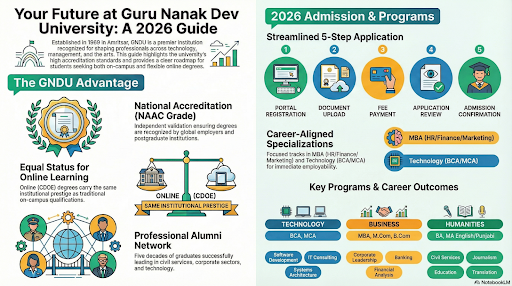
There are universities that offer programmes, and there are universities that shape professionals. Guru Nanak Dev University, Punjab, established in 1969 in the city of Amritsar, belongs firmly in the second category. Founded to honour the 500th birth anniversary of Guru Nanak Dev Ji, the university was built on principles of knowledge, service, and equality — values that continue to inform its academic culture and its relationship with students across disciplines and backgrounds.
Over more than five decades, the university has built a record that speaks directly to the question every prospective student should ask: does this institution produce graduates who are genuinely prepared for professional and personal life? The evidence at GNDU University is consistent. Its alumni are present across civil services, corporate leadership, academia, technology, law, and the arts — not as exceptions, but as a pattern. That pattern reflects the quality of the academic environment in which they were formed, and it is the most meaningful assurance a prospective student can have when evaluating where to invest their formative years.
An institution's history is not merely heritage — it is evidence. Guru Nanak Dev University's six-decade record of producing professionals across every major field is the most meaningful indicator of what a student can expect from their time there.
1. Understanding GNDU: What the Name Carries and What the University Stands For
The GNDU full form — Guru Nanak Dev University — is not simply an institutional name. It carries the philosophical weight of a tradition that values learning as a means of human development, not merely professional qualification. This orientation shapes the academic culture at the university in ways that are tangible: faculty engagement that extends beyond examination preparation, a curriculum that connects disciplinary knowledge to broader societal questions, and a campus environment that values critical thinking alongside technical proficiency.
Located in Amritsar, GNDU Amritsar is not simply a Punjab institution — it draws students from across India and maintains international academic relationships that extend its reach and its relevance. The university's presence across undergraduate, postgraduate, doctoral, and professional programmes means that students can pursue a continuous educational journey within a single academic community, building on each stage of their preparation without the disruption of changing institutional environments.
GNDU is more than a qualification provider — it is an academic community with a defined set of values that shapes how students learn, how faculty teach, and how graduates carry themselves professionally. Understanding this context helps students appreciate what they are entering, not just what they will receive.
2. Accreditation and Academic Standing: What GNDU's Recognition Actually Means
For students and families evaluating universities, accreditation is one of the most reliable external signals of institutional quality — and GNDU NAAC Grade recognition reflects a rigorous, independent assessment of the university's academic standards, infrastructure, governance, research output, and student support systems. NAAC accreditation is not a courtesy; it involves a detailed review across multiple parameters and is renewed periodically, meaning that an institution's standing must be maintained, not simply earned once.
What this means practically for students is that a degree from Guru Nanak Dev University carries external validation that employers and postgraduate institutions recognise. When a graduate presents their qualification to a recruiter or a foreign university admissions committee, the NAAC accreditation provides independent assurance of the academic environment in which that degree was earned. In a landscape where many institutions make broad claims about quality, accreditation provides a verified and comparable reference point that matters.
NAAC accreditation is an independent, evidence-based assessment of institutional quality. For students, it provides assurance that the qualification they are earning has been evaluated against national standards — and found to meet them.
Have questions about programmes or admissions at Guru Nanak Dev University? Contact us today, and our team will guide you through every step of your application journey.
3. Programmes at GNDU: A Complete Reference for Prospective Students
Online Guru Nanak Dev University offers a range of undergraduate and postgraduate programmes that span commerce, technology, management, and language, each designed to develop both disciplinary depth and professional capability. The table below provides a brief description of each programme to help students understand what each one involves and what it prepares graduates to do.
| Programme | Brief Description |
|---|---|
| Bachelor of Arts (B.A.) | A three-year undergraduate programme developing critical thinking, cultural literacy, and communication capability across humanities and social science disciplines. Prepares graduates for careers in civil services, education, journalism, law, and public administration. |
| Bachelor of Computer Applications (BCA) | Bachelor of Computer Applications — a three-year programme building foundational programming, database management, and software development skills. Prepares graduates for technology roles in software development, IT consulting, and systems analysis. |
| Bachelor of Commerce (B.Com) | A three-year commerce programme developing expertise in financial accounting, taxation, business law, and auditing. Provides a strong foundation for professional certifications such as CA and CMA, as well as careers in banking, finance, and corporate accounting. |
| MBA (General) | A two-year generalist management programme developing cross-functional business capability across strategy, operations, finance, and leadership. Prepares graduates for management roles across industries and sectors. |
| MBA – Human Resource Management | A specialised MBA developing expertise in talent acquisition, organisational behaviour, performance management, and employment law. Prepares graduates for human resources leadership roles in organisations of all sizes. |
| MBA – Marketing | A specialised MBA building capability in consumer behaviour, brand management, digital marketing, and market research. Prepares graduates for marketing, brand, and communications leadership roles. |
| MBA – Finance | A specialised MBA developing advanced competency in corporate finance, investment analysis, risk management, and financial modelling. Prepares graduates for senior roles in banking, investment, and corporate financial management. |
| Master of Computer Applications (MCA) | Master of Computer Applications — a two-year programme developing advanced software engineering, systems architecture, and project management capability. Prepares graduates for senior technology roles in product companies, IT consulting, and enterprise development. |
| M.Com | A two-year postgraduate commerce programme developing advanced expertise in accounting, taxation, finance, and economic analysis. Well-suited to students pursuing professional certifications alongside their postgraduate study. |
| MA English | A two-year postgraduate programme developing advanced literary analysis, critical theory, academic writing, and cross-cultural communication. Prepares graduates for careers in content strategy, publishing, education, journalism, and translation. |
| MA Punjabi | A two-year postgraduate programme developing deep linguistic expertise and cultural understanding in the Punjabi language and literature. Prepares graduates for roles in translation, media, public administration, education, and cultural heritage. |
4. Applying to GNDU in 2026: A Clear and Practical Guide to the Process
The admission process at Guru Nanak Dev University for 2026 is designed to be accessible and straightforward, allowing students to focus on their preparation rather than on navigating administrative complexity. The following table maps each step of the process clearly, with practical guidance on what students should keep in mind at each stage.
| Step | Action | What to Keep in Mind |
|---|---|---|
| 01 | Click Apply Now | Begin the process by accessing the official application portal. Ensure you are using the correct URL and that the portal is open for the programme and intake you are applying to. |
| 02 | Fill in the Application Form | Complete all required fields accurately. Double-check personal details, academic history, and programme selection before proceeding. Errors at this stage can cause delays in processing. |
| 03 | Submit the Required Documents | Upload supporting documents as specified — typically including Class 10 and 12 mark sheets, a passport-size photograph, identity proof, and category certificates where applicable. Ensure all documents are clear and correctly formatted. |
| 04 | Pay the Application Fee | Complete the application fee payment through the designated payment gateway. Keep a record of the transaction confirmation for your files. |
| 05 | Wait for Confirmation | After submission, monitor the email address provided in your application for confirmation and any further communication. Shortlisting, merit list publication, and admission offer timelines vary by programme. |
The admission process is straightforward — but attention to detail at each step matters. Accurate documentation, timely submission, and careful monitoring of communications after application will ensure the process moves smoothly and without avoidable delays.
5. GNDU's Online and Distance Education: Expanding Access Without Reducing Standards
The Centre for Distance and Online Education at Guru Nanak Dev University extends the university's academic offerings to students who cannot attend campus-based programmes. Whether due to professional commitments, geographic constraints, or personal circumstances, many students benefit from the flexibility that online and distance learning provides — and GNDU's CDOE is designed to deliver this flexibility without compromising the academic rigour that the university's name represents.
Programmes offered through GNDU's distance and online channels follow the same curriculum standards as their on-campus equivalents. Students receive structured academic support, access to learning resources, and are assessed on the same academic criteria. The qualifications awarded carry the same institutional recognition — a degree from GNDU is a degree from GNDU, regardless of the mode through which it was earned. For working professionals seeking to upgrade their qualifications, for students managing family responsibilities, and for learners in regions where campus access is limited, this is a meaningful and credible option.
GNDU's online and distance programmes are not a compromise on quality — they are a deliberate extension of the university's academic offering to students whose circumstances require greater flexibility. The qualification earned carries the same credibility as any other GNDU degree.
6. Why Students Choose GNDU CDOE: The Reasons That Go Beyond Convenience
Students who choose GNDU University's Centre for Distance and Online Education do so for reasons that extend well beyond the flexibility of the format. The GNDU CDOE combines the credibility of one of Punjab's most respected universities with the accessibility of online delivery — a combination that is not available at every institution. Students studying through CDOE benefit from a qualification that is recognised by employers and postgraduate institutions across India, a curriculum developed and overseen by the same faculty that delivers on-campus programmes, and an academic support structure that understands the specific needs of distance learners.
For working professionals already in employment, GNDU CDOE provides a pathway to postgraduate qualifications — particularly in management and commerce — that can be pursued alongside professional responsibilities. This means that the investment in education produces returns in two directions simultaneously: the qualification being earned, and the professional experience being accumulated while it is being studied. Graduates who complete GNDU CDOE programmes consistently cite the combination of institutional credibility and learning flexibility as the primary reasons their decision was well-made.
Choosing GNDU CDOE is a decision that combines academic credibility with practical flexibility — two things that students rarely find at the same institution. For the profile of students that CDOE is designed to serve, this combination is genuinely difficult to find elsewhere.
7. An Honest Assessment: What GNDU Does Well and What Students Should Factor In
Every institution has strengths that make it the right choice for certain students, and considerations that make it less suited for others. The following assessment of Guru Nanak Dev University, Punjab is intended to help students make an informed decision — not to create an unrealistically positive or negative impression, but to provide the kind of balanced view that genuinely useful guidance requires.
| ✔ Strengths | ⚠ Considerations |
|---|---|
| ✔ Strong NAAC accreditation providing nationally recognised academic credibility | ⚠ High demand for popular programmes means competitive admission — early preparation matters |
| ✔ A broad programme range serving students across arts, commerce, technology, and management | ⚠ Distance learning requires strong self-discipline; students who need structured in-person support may find the format challenging |
| ✔ Established alumni network with presence across major professions and industries | ⚠ Campus infrastructure and facilities vary across departments — students should research specific schools within the university |
| ✔ Online and distance education options extend access without compromising qualification quality | ⚠ Some niche career pathways may require supplementary professional certifications alongside the degree |
| ✔ Specialist MBA streams allowing focused professional preparation in HR, Marketing, and Finance | ⚠ Admission timelines and seat availability can change year to year — students should verify current information directly |
| ✔ Postgraduate programmes well-aligned with professional certification pathways (CA, CMA) | ⚠ — |
| ✔ Established research culture supporting academic depth and faculty engagement | ⚠ — |
GNDU's strengths are substantial and well-documented. The considerations listed are not disqualifying — they are factors that students should be aware of and plan around. Most can be addressed through informed preparation and realistic expectation-setting before enrolment.
8. Making the Decision: What Students Who Choose GNDU Are Choosing
Choosing to study at Guru Nanak Dev University is, at its core, a decision to invest one's formative academic years in an institution with a demonstrated commitment to academic quality, a broad range of career-relevant programmes, and a culture that values both intellectual rigour and personal development. For students in Punjab and across India who are weighing their options, GNDU represents a combination of institutional credibility, programme breadth, and accessibility that is genuinely difficult to replicate elsewhere.
The right programme is the one that aligns with a student's genuine interests, academic strengths, and professional ambitions — and GNDU's range means that this alignment is achievable for students with very different profiles and directions. Whether a student is drawn to the analytical demands of commerce, the communicative depth of language and arts, the technical rigour of computer applications, or the strategic scope of management, the university has a programme designed to develop that capability to a professional standard.
What remains consistent across every programme and every student who passes through GNDU's academic environment is the quality of the foundation they build — a foundation that supports not just the first role after graduation, but the full arc of a professional career.
The best course for any student is the one chosen with clarity — about what it develops, what it enables, and why it aligns with where that student is headed. At Guru Nanak Dev University, the range of well-designed programmes means that this clarity, once found, can be acted on.