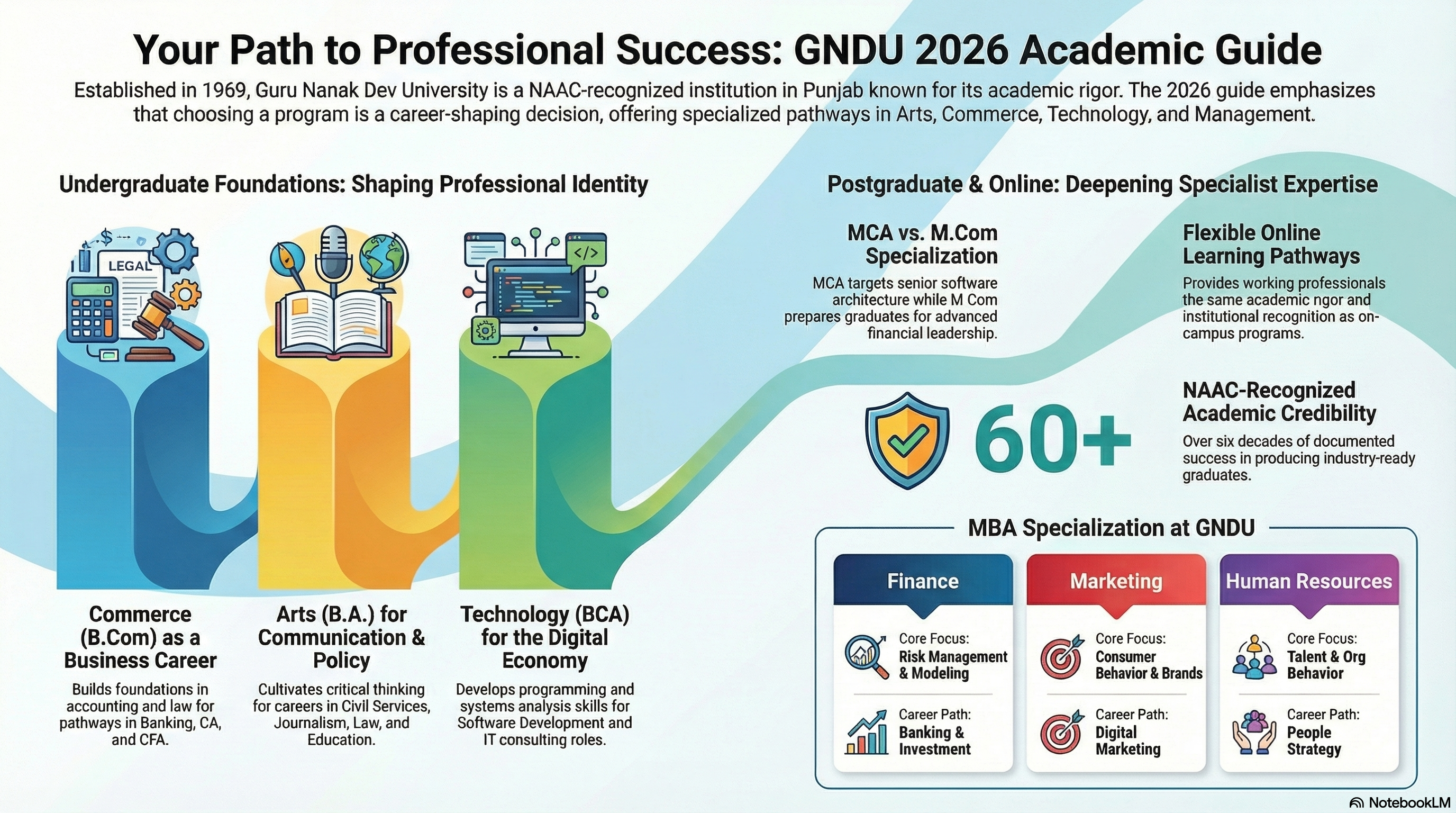
When students and families in Punjab evaluate where to pursue higher education, Guru Nanak Dev University courses occupy a position that goes beyond institutional familiarity. Established in 1969 and built on a legacy of academic excellence, social responsibility, and cross-disciplinary breadth, the university has consistently produced graduates who contribute meaningfully across every major profession — from public administration and law to technology, commerce, education, and the arts.
What makes GNDU courses a compelling choice for students at the undergraduate and postgraduate level is not simply its heritage — it is the range and depth of its academic offerings, designed to meet the demands of a job market that is simultaneously more competitive and more diverse than at any previous point. The university's programmes span commerce, technology, arts, management, and language — each designed not merely to confer a qualification, but to equip graduates with the analytical, professional, and communicative capabilities that careers in these fields genuinely require.
Guru Nanak Dev University is not simply a well-known name — it is an institution with a documented record of producing graduates who are prepared for the professional demands of their chosen fields. For students making a decision about where to invest their undergraduate or postgraduate years, that record matters.
1. Undergraduate Programmes: Where Academic Depth Meets Professional Direction
The undergraduate years are where professional identity begins to form. The programme a student chooses at this stage does not merely determine a subject of study — it shapes the reasoning habits, communication styles, and analytical frameworks that will define how they approach problems for the rest of their career. Courses in GNDU Amritsar offer undergraduate programmes across arts, commerce, and technology — each opening a distinct set of career pathways that are worth understanding before a decision is made.
When a Commerce Degree Becomes a Business Career
A commerce programme at the undergraduate level is among the most versatile investments a student can make. The B.Com at Guru Nanak Dev University builds a rigorous foundation in financial accounting, taxation, business law, economics, and auditing — producing graduates who understand how organisations create, manage, and report value. This foundation opens pathways into chartered accountancy, cost management accounting, banking, financial analysis, and corporate finance. Students who pursue B.Com with an eye on professional certifications — CA, CMA, CFA — find that the undergraduate curriculum provides exactly the conceptual grounding these examinations require. Those who choose to enter the workforce directly find that their accounting and compliance literacy places them in roles with immediate utility to any organisation of financial significance.
When an Arts Degree Becomes a Career in Ideas, People, and Communication
The arts are often mischaracterised as impractical — a misreading that consistently disadvantages students who would otherwise thrive in fields that value exactly what arts programmes develop. The Bachelor of Arts at Guru Nanak Dev University cultivates critical thinking, historical contextualisation, cultural literacy, and the ability to communicate complex ideas with precision and nuance. These are the capabilities that underpin careers in public administration, civil services, journalism, policy research, law, social work, education, and international relations. Students who approach the programme with professional intention — engaging deeply with their chosen disciplines and developing strong written and verbal communication alongside their coursework — emerge with a profile that is more broadly applicable than most people entering the programme initially recognise.
When a Technology Degree Becomes a Digital Career
For students drawn to the logic of systems, the architecture of software, and the analytical demands of the digital economy, the BCA — Bachelor of Computer Applications — provides a structured three-year pathway into technology careers. At Guru Nanak Dev University, the programme develops programming proficiency, database management, software development methodology, and systems analysis, equipping graduates for roles in software development, IT consulting, systems administration, and digital project management. BCA graduates who pursue postgraduate study in computer science or management find that their technical foundation, combined with higher-level analytical training, creates a particularly strong profile for senior technology and product roles.
Undergraduate programme selection is a career-shaping decision, not merely an academic one. Each of GNDU's undergraduate offerings develops a distinct professional profile — students who understand what that profile enables are better positioned to choose with intention and pursue with purpose.
Ready to explore the right programme for your interests and career goals? Contact us to learn more about admissions at Guru Nanak Dev University and find the path that is built for you.
2. Postgraduate Programmes: Deepening Expertise and Expanding Professional Reach
A postgraduate qualification at a university is not simply a continuation of undergraduate study — it is a professional repositioning. At the master's level, the expectations are higher, the peer group is more professionally experienced, and the outcomes are more directly tied to senior and specialist career entry. Understanding what each postgraduate programme develops — and what it makes possible — is essential for students evaluating which direction to pursue.
Management Programmes: Building Leaders Across Functions
The MBA at Guru Nanak Dev University develops the cross-functional management capability that organisations in every sector require at the leadership level. But the university's management offerings extend beyond the generalist qualification to address the specific functional demands of modern organisations.
The MBA HR develops expertise in talent acquisition, organisational behaviour, performance management, and employment law — producing graduates equipped for roles at the intersection of people strategy and business performance. The MBA Marketing builds capability in consumer behaviour, brand management, digital marketing, and market research — preparing graduates for careers in one of the most dynamic and data-driven functions in any organisation. The MBA Finance develops advanced competency in corporate finance, investment analysis, risk management, and financial modelling — opening pathways into banking, investment, corporate treasury, and financial consulting at a senior level.
Each of these specialisations represents a distinct career trajectory. The decision between them should be driven by a genuine understanding of where one's analytical and interpersonal strengths lie, and which professional environments one finds most engaging — not simply by the perceived prestige of a given functional area.
Technology at the Postgraduate Level: What MCA Opens
The MCA — Master of Computer Applications — is designed for graduates who wish to deepen their technology expertise and position themselves for senior roles in software development, systems architecture, and IT leadership. At Guru Nanak Dev University, the programme develops advanced programming, software engineering, database systems, and project management capability — building on undergraduate foundations to produce graduates who are ready to contribute to complex technical environments from the outset of their professional practice. MCA graduates are particularly well-positioned for roles in product companies, technology consulting, and enterprise software development, where the combination of technical depth and systems-level thinking commands consistent and growing demand.
Commerce at the Postgraduate Level: What M.Com Enables
The M.Com at Guru Nanak Dev University is designed for graduates who wish to develop advanced expertise in accounting, taxation, finance, and economic analysis. It is a programme particularly well-suited to students pursuing professional certifications such as CA or CMA alongside their postgraduate study, as the curriculum provides both the theoretical depth and the applied commercial understanding that these qualifications require. M.Com graduates enter the workforce with the analytical rigour and financial literacy to contribute to accounting firms, corporate finance departments, tax consultancies, and financial regulatory bodies — and to progress toward senior financial leadership with a more complete academic foundation than a bachelor's degree alone provides.
Language and Literature at the Postgraduate Level: What MA English and MA Punjabi Build
Language is one of the most underestimated assets in professional life — and postgraduate study in language and literature develops it to a level of precision and depth that few other disciplines match. The MA English at Guru Nanak Dev University develops advanced literary analysis, critical theory, academic writing, and cross-cultural communication — capabilities that are directly applicable in content strategy, publishing, education, journalism, translation, and cultural administration.
The MA Punjabi develops deep linguistic expertise and cultural understanding in one of India's most significant regional languages, opening pathways in translation, media, public administration, education, and the preservation and promotion of Punjabi literary heritage. In an economy where multilingual communication is increasingly valuable — and where regional language content is expanding rapidly — graduates with this depth of language expertise are genuinely differentiated.
Postgraduate programmes at GNDU are not generic qualifications — each develops a specific professional profile with clearly defined career applications. Students who choose their postgraduate direction with an understanding of what it builds and why consistently arrive at graduation better prepared than those who choose on reputation alone.
3. Online Learning at GNDU: Access Without Compromise on Academic Rigour
The expansion of online education at GNDU Amritsar reflects a broader recognition that access to quality higher education should not be constrained by geography, professional commitments, or personal circumstances. The university's online programmes are designed on the same academic principles as their on-campus equivalents — maintaining the rigour, faculty engagement, and assessment standards that the GNDU name represents, while extending access to students who require greater flexibility in how they engage with their studies.
For working professionals seeking to add a postgraduate qualification without interrupting their careers, for students in regions where campus attendance is impractical, and for learners who benefit from the self-directed structure of online study, GNDU's online offerings represent a credible and credentialed pathway. The value of an online qualification from an institution of GNDU's standing is grounded in the same academic quality assurance that governs its campus programmes — and graduates enter the job market with a qualification that carries the same institutional recognition.
Online learning at GNDU is not a compromise — it is a different mode of accessing the same quality of academic preparation. For students whose circumstances make campus attendance difficult, it represents a genuine and credible pathway to a recognised qualification.
4. Matching the Right Programme to the Right Ambition: How to Think About This Decision
The question of which programme at Guru Nanak Dev University best suits a particular student is not one that can be answered generically — it depends on a combination of academic background, professional interests, career goals, and the kind of environment in which a student does their best work. What can be offered, however, is a framework for thinking about this decision that goes beyond subject preference or peer influence.
Students drawn to numbers, business operations, and financial systems will find that commerce programmes — at both the undergraduate and postgraduate level — provide the most direct pathway to the careers they are building toward. Students with strong communication skills, intellectual curiosity across disciplines, and an interest in public life, culture, or education will find that arts and language programmes develop exactly the capabilities those careers require. Students with a logical orientation, an interest in how systems work, and comfort with programming and mathematical thinking will find that technology programmes at GNDU open the widest range of digital economy careers. And students who are ready to make a commitment to professional leadership — who have clarity about the functional area in which they want to build expertise — will find that GNDU's postgraduate management offerings provide the structured, applied preparation that leadership roles in finance, marketing, and human resources genuinely demand.
The GNDU full form — Guru Nanak Dev University — carries a meaning that extends beyond the name itself. It represents an institution that has invested decades in building a learning environment where students from diverse backgrounds and with diverse ambitions can find a programme that is genuinely right for them. The breadth of offerings is not incidental — it reflects a considered understanding that career pathways are as varied as the students who pursue them, and that a university worth its standing should be able to serve that variety with equal quality.
Programme selection is most effective when it is grounded in self-knowledge — an honest assessment of academic strengths, professional interests, and career ambitions — rather than in conventional prestige rankings or peer pressure. GNDU's range of programmes means that the right fit exists for a wide variety of student profiles; finding it requires asking the right questions first.
5. The Institution Behind the Qualification: Why GNDU's Standing Matters
A qualification is only as valuable as the institution that confers it — and in that regard, students choosing GNDU University are making a decision backed by more than six decades of academic credibility. The university's sustained NAAC recognition reflects not simply its historical reputation, but its ongoing commitment to academic quality, faculty development, student support, and the continuous improvement of its programmes in response to professional and societal change.
For employers evaluating candidates, a degree from Guru Nanak Dev University carries a signal of academic preparation that is consistently respected across sectors and geographies. For students, it represents the assurance that the four years — or two years at the postgraduate level — invested in their education have been structured by an institution that takes seriously its responsibility to produce graduates who are genuinely ready for what comes next.
The decision about where to study is ultimately a decision about what kind of professional one wants to become, and how seriously one's institution takes its role in helping make that happen. At Guru Nanak Dev University, the answer to that question is documented in the outcomes of the generations of graduates who have built meaningful careers on the foundation it provided.
Choosing a programme at GNDU is not simply an enrolment decision — it is the beginning of a professional journey supported by one of Punjab's most established and respected academic institutions. The right programme, pursued with intention, is where that journey begins well.