The Bachelor of Computer Applications at Guru Nanak Dev University is a three-year undergraduate programme designed for students who want to build a serious foundation in computing, software development, and information technology. It is not a generalist degree that touches lightly on technology — it is a structured, discipline-focused qualification that develops the programming capability, analytical thinking, and systems understanding that technology careers genuinely require.
The GNDU Computer Science Department brings academic rigour and applied relevance to the BCA curriculum, ensuring that graduates are not simply trained in tools that may become obsolete, but in the foundational principles of computing that remain relevant as the technology landscape evolves. For students who are clear that a career in software development, IT consulting, systems analysis, or digital product work is their direction, the BCA at GNDU is a well-designed and credibly supported pathway to that destination.
The BCA at GNDU is not an introduction to computing — it is a professional preparation. Students who engage with the programme seriously emerge with the technical foundation and analytical confidence that technology employers consistently look for in entry-level candidates.
1. Who Is Eligible to Apply: Entry Requirements for the BCA Programme
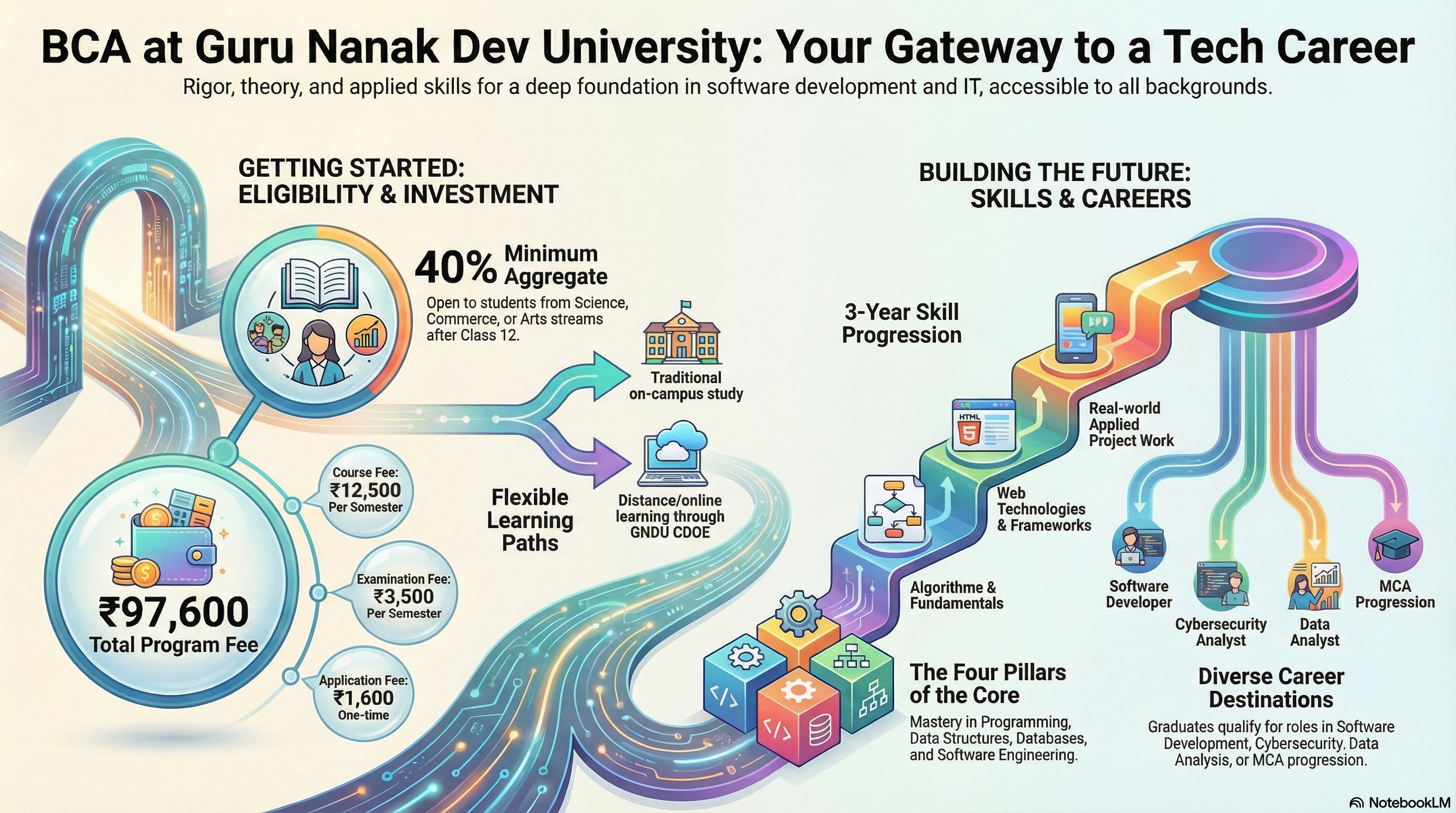
The eligibility criteria for the BCA programme at Guru Nanak Dev University are designed to be accessible to students from a range of academic backgrounds, while ensuring that those admitted have the foundational preparation to engage productively with the programme. Admission requires completion of the 10+2 examination — or an equivalent qualification from a recognised board — with a minimum aggregate score of 40%. There is no stream restriction: students from science, commerce, and arts backgrounds are all eligible to apply, provided they meet the aggregate requirement.
This inclusivity is deliberate. Computing and technology are cross-disciplinary fields, and the BCA curriculum is designed to build technical proficiency from the ground up — meaning that a strong prior background in mathematics or science, while advantageous, is not a prerequisite for successful completion of the programme. Students who bring discipline, curiosity, and a genuine interest in how technology works will find the programme accessible and rewarding, regardless of the stream they studied in Class 12.
The BCA's 40% aggregate eligibility threshold reflects the programme's commitment to access — but admission is only the beginning. Students who arrive with intellectual curiosity and a willingness to engage seriously with the curriculum consistently find the programme more rewarding than those who arrive without a clear sense of why they chose it.
Interested in applying for BCA at Guru Nanak Dev University? Contact Us to get complete details on the admission process, important dates, and everything you need to begin your application.
2. What the BCA Curriculum Covers: A Subject-Domain Overview
| Domain | Subject Areas Covered |
|---|---|
| Programming Foundations | Problem solving, algorithms, flowcharts, C programming, Python, and object-oriented programming principles. |
| Mathematics & Statistics | Discrete mathematics, numerical methods, probability, statistics, and their applications in computing contexts. |
| Data Structures & Algorithms | Arrays, linked lists, stacks, queues, trees, graphs, searching and sorting algorithms, and algorithm complexity. |
| Database Systems | Relational database concepts, SQL, database design, normalisation, transaction management, and database administration fundamentals. |
| Operating Systems | Process management, memory management, file systems, scheduling algorithms, and multi-threading concepts. |
| Networking & Communication | Computer networks, TCP/IP, network protocols, internet architecture, cybersecurity fundamentals, and cloud computing basics. |
| Software Engineering | Software development lifecycle, project planning, requirement analysis, testing methodologies, and version control practices. |
| Web Technologies | HTML, CSS, JavaScript, web application development, server-side scripting, and introduction to modern frameworks. |
| Emerging Technologies | Introduction to artificial intelligence, machine learning concepts, data analytics, and mobile application development. |
| Project Work | Individual or group projects applying the technical skills developed across the programme to defined problem statements. |
The GNDU syllabus 2026 BCA reflects the current demands of the technology industry — incorporating both foundational computing principles that have remained stable across decades and applied areas such as data analytics, cloud computing, and emerging technologies that reflect the directions in which the profession is actively moving. Students who engage with the full breadth of this curriculum emerge with a profile that is genuinely applicable across a wide range of technology roles.
The BCA curriculum at GNDU is designed as a progression — each domain builds on the previous one, and the applied project work at the end requires students to synthesise learning from across the programme. Students who engage consistently, rather than selectively, develop the most complete and career-ready skill set.
3. The Subjects That Form the Technical Core of the Degree
Within the broader BCA syllabus GNDU, certain subject areas form the irreducible technical core of the degree — the disciplines that every BCA graduate must understand deeply, regardless of the specific career direction they pursue after graduation. These are the subjects that underpin everything else in the programme and the ones that employers most consistently assess when evaluating BCA candidates.
Programming is the most fundamental of these. Whether a BCA graduate goes on to develop software, manage databases, work in cybersecurity, or move into technology consulting, the ability to read, write, and debug code is a baseline professional expectation. Data structures and algorithms follow closely — these are the conceptual tools that allow a programmer to solve problems efficiently, and proficiency in them is what separates a technical candidate who can only follow templates from one who can genuinely think through novel problems. Database management is the third core pillar: virtually every technology system interacts with data at some level, and the ability to design, query, and manage databases is a skill that applies across almost every technology role. Software engineering — the discipline of building systems that are maintainable, testable, and scalable — rounds out the technical core, giving graduates the professional vocabulary and methodology to contribute to real development environments from their first day of work.
The core subjects of the BCA are not simply examination requirements — they are the professional fundamentals that every technology employer expects. Students who master these four areas — programming, data structures, databases, and software engineering — arrive at the job market with the credibility to claim genuine technical capability.
4. Understanding the Full Cost of the BCA at GNDU: A Transparent Fee Breakdown
Planning for the financial investment of a degree programme requires clarity about what the total cost involves and how it is structured across the duration of study. The BCA at Guru Nanak Dev University is a three-year, six-semester programme, and the fee structure is transparent and consistent across semesters. The following table presents the complete breakdown.
| Fee Component | Amount | Frequency |
|---|---|---|
| Course Fee | ₹12,500 per semester | Payable each semester (6 semesters) |
| Examination Fee | ₹3,500 per semester | Payable each semester (6 semesters) |
| Application Fee (one-time) | ₹1,600 | Paid once at the time of application |
| Total Programme Fee (3 Years) | ₹97,600 | All components included |
The total programme fee of ₹97,600 covers the complete three-year BCA, including all course and examination components. The one-time application fee of ₹1,600 is payable at the point of application and is not repeated. The per-semester structure — ₹16,000 per semester in course and examination fees combined — allows students and families to plan payments in manageable instalments rather than as a single lump sum.
The BCA fee structure at GNDU is transparent and predictable. The per-semester payment model makes financial planning straightforward, and the total investment of ₹97,600 over three years is well within the range of comparable programmes at accredited institutions across India.
5. Where a BCA from GNDU Takes Graduates: Career Pathways and Progression
A BCA from Guru Nanak Dev University opens a range of technology career pathways — both for graduates who enter the workforce directly after the degree and for those who pursue postgraduate qualifications before doing so. The programme's combination of programming depth, systems knowledge, and applied project experience positions graduates for entry-level roles across software development, IT operations, data management, and digital services.
| Career Role | What It Involves |
|---|---|
| Software Developer | Designs, builds, and tests software applications across web, mobile, and enterprise platforms. One of the most direct and common pathways for BCA graduates. |
| Web Developer | Develops and maintains websites and web applications. Front-end, back-end, and full-stack roles are all accessible with the web technologies component of the BCA curriculum. |
| Database Administrator | Manages and maintains database systems — ensuring performance, security, and availability. Directly supported by the database management subjects in the BCA curriculum. |
| Systems Analyst | Evaluates and improves the technology systems used by organisations. Requires both technical understanding and the ability to communicate with non-technical stakeholders. |
| IT Support Specialist | Provides technical support for hardware, software, and network issues within organisations. An accessible entry-level role with clear progression pathways. |
| Cybersecurity Analyst | Monitors and protects organisational systems from threats and vulnerabilities. An area of growing demand supported by the networking and security components of the BCA. |
| Data Analyst | Collects, processes, and interprets data to support organisational decision-making. Increasingly accessible to BCA graduates who develop proficiency in data tools and statistical methods. |
| MCA / Postgraduate Study | BCA is the standard prerequisite for MCA admission. Graduates who pursue MCA access more senior and specialist technology roles, including systems architecture and technology leadership. |
BCA graduates from GNDU enter a job market with genuine and growing demand for the skills they have developed. The programme's breadth means that graduates are not limited to a single career pathway — they have the foundational capability to move across several technology functions and to develop specialisation as their careers progress.
6. Why GNDU CDOE Is a Credible Choice for BCA Students Who Need Flexibility
For students who cannot attend a campus-based programme — whether due to geographic location, financial constraints that require part-time work, or personal responsibilities — Guru Nanak Dev University's Centre for Distance and Online Education offers a BCA pathway that carries the same institutional credibility as the campus equivalent. The qualification awarded is the same GNDU degree, assessed against the same academic standards, and recognised by the same range of employers and postgraduate institutions.
What GNDU CDOE offers that campus study does not is the ability to manage the pace and location of learning around other commitments. This is not a feature that benefits every student — those who thrive in structured, peer-intensive environments are generally better served by campus study. But for students whose circumstances make that impractical, the university provides a route to a meaningful and credible technology qualification that does not require them to put the rest of their lives on hold.
GNDU CDOE's BCA is the right choice for students who need flexibility without compromising on institutional credibility. For those whose circumstances allow campus attendance, the on-campus experience offers additional peer learning and networking benefits that the online format cannot fully replicate.
7. A Balanced View: Strengths and Considerations for Prospective BCA Students
Making an informed decision about a programme requires honest engagement with both what it does well and what it requires from the student. The following assessment is offered as a practical reference for students who want to understand what they are committing to before they commit.
| ✔ Strengths | ⚠ Considerations |
|---|---|
| ✔ NAAC-accredited institution providing nationally recognised qualification credibility | ⚠ 40% eligibility threshold is accessible, but the programme demands consistent academic engagement to realise its career potential |
| ✔ Broad curriculum covering programming, databases, networking, and emerging technologies | ⚠ Students seeking highly specialised AI or fintech tracks may benefit from dedicated B.Tech programmes instead |
| ✔ Open to students from all streams — science, commerce, and arts equally eligible | ⚠ Distance learners need strong self-direction; the format rewards those who manage their own time effectively |
| ✔ Transparent and predictable fee structure of ₹97,600 over three years | ⚠ Entry-level salaries vary significantly by city, employer, and the student's applied skill level at graduation |
| ✔ Strong pathway to MCA and postgraduate technology qualifications | ⚠ Competitive postgraduate entry (especially MCA) requires strong academic performance throughout the BCA |
| ✔ Online/distance option available through GNDU CDOE for students who need flexibility | ⚠ — |
| ✔ Career scope spans multiple technology functions — not limited to a single role type | ⚠ — |
The BCA at GNDU is a strong programme for students who are genuinely interested in technology and willing to engage seriously with a rigorous curriculum. The considerations listed are real but manageable — most can be addressed through deliberate preparation and consistent academic effort throughout the three years.
8. The BCA as a Career Foundation: What Three Years at GNDU Builds
A BCA from Guru Nanak Dev University is not simply an undergraduate qualification — it is the beginning of a professional identity in technology. The three years of the programme are designed to develop not just technical proficiency, but the analytical habits, problem-solving orientation, and professional confidence that allow a graduate to contribute meaningfully from their first role and to develop consistently in the years that follow.
Students who approach the BCA with clarity of purpose — who understand what the programme develops, what careers it opens, and what it requires of them — consistently emerge better prepared than those who treat it as a qualification to collect. The curriculum is rigorous and broad; the career outcomes are genuine and varied; and the institutional backing of Guru Nanak Dev University provides the credibility that makes those outcomes accessible. For students choosing where to build their technology foundation, the BCA at GNDU is a considered and credible answer to that question.
Three years is a significant investment of time, effort, and financial resources. The BCA at GNDU is designed to make that investment worthwhile by producing graduates who arrive at the technology job market with the technical depth, the applied experience, and the institutional credential that employers in this field consistently look for.