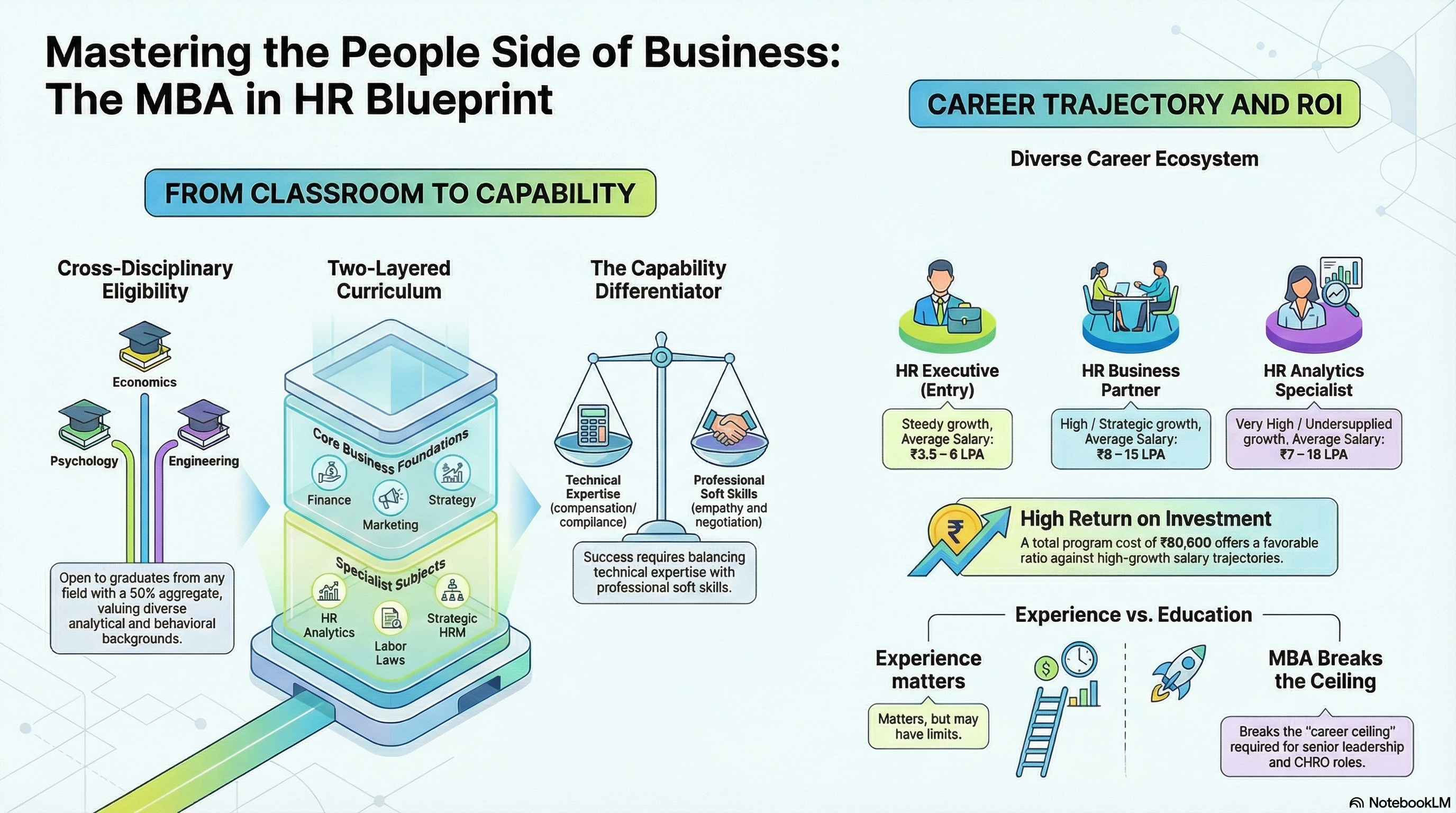
The decision to specialise in human resources within an MBA is not, as some students assume, a default choice for those uncertain about finance or marketing. It is an increasingly deliberate and strategically sound career decision. Organisations across every sector — technology, manufacturing, financial services, healthcare, education, and public administration — are confronting workforce challenges that require professional expertise to navigate: talent scarcity, remote work management, diversity and inclusion imperatives, workforce analytics, and the organisational implications of automation. The professionals equipped to address these challenges are those who have developed their HR in MBA course preparation seriously, with a clear understanding of what the specialisation builds and where it leads.
What makes HR a compelling MBA specialisation is its positioning at the intersection of business strategy and human psychology. Effective HR professionals do not simply administer policies; they design structures that allow organisations to attract capability, retain talent, and execute strategy effectively. For students considering this path, the primary question is practical: what exactly does a career after an MBA in HR look like?
1. The Core Roles: Where Do HR Professionals Start?
Graduates entering the workforce immediately after completing an MBA in HR typically begin in foundational roles designed to build operational understanding of human resource management.
| Entry-Level Role | Core Responsibilities | Why It Matters |
|---|---|---|
| HR Generalist | Manages a broad spectrum of HR functions including onboarding, policy administration, employee relations, and basic compliance. | Provides the comprehensive grounding required to understand how different HR functions interact within a business. |
| Talent Acquisition Specialist | Manages the recruitment lifecycle — from employer branding and candidate sourcing to interviewing, offer negotiation, and onboarding. | Builds the fundamental skill of evaluating capability and aligning candidate profiles with organisational requirements. |
| Learning & Development Coordinator | Assists in designing, implementing, and evaluating training programmes, capability building initiatives, and leadership development frameworks. | Develops an understanding of how to assess skill gaps and design interventions to improve workforce capability. |
These roles are developmental. They are designed to transition graduates from academic understanding to operational competence, typically within the first two to three years of their careers.
2. The Specialist Tracks: Where the Field Is Moving
As professionals build experience, the trajectory of an HR career often moves from generalist administration to strategic specialisation. The HR landscape is evolving rapidly, and the highest-value opportunities are increasingly found in specialist domains.
The shift towards data-driven decision-making has fundamentally changed HR. Roles combining human resource understanding with analytical capability are currently seeing the highest demand growth in the sector.
Strategic Roles and Specializations:
- HR Business Partner (HRBP): This is the crucial bridge between HR strategy and business execution. HRBPs work directly with business unit leaders to align talent strategy with commercial objectives. They do not merely execute HR policy; they advise business leaders on organisational design, succession planning, and performance management.
- Compensation and Benefits Manager: Also known as Total Rewards, professionals in this track design the structures that attract and retain talent. It requires strong analytical capability, an understanding of market data, and the ability to design incentive structures that drive required behaviours while managing organisational cost.
- HR Analytics Specialist: This is currently one of the fastest-growing specialisations. These professionals apply data science principles to workforce data — analysing turnover predictors, evaluating the return on investment of training programmes, and building models to inform workforce planning.
- Organisation Development (OD) Consultant: Rather than managing daily HR operations, OD specialists focus on the structural and cultural health of the organisation. They manage change initiatives, design performance frameworks, and work to improve overall organisational effectiveness.
3. Salary and Growth: What Can You Expect?
Remuneration for MBA in HR graduates varies significantly based on factors such as the reputation of the institution granting the degree, the sector of employment, and the geographic location of the role. However, standard trajectories provide a useful baseline for expectation management.
| Career Stage | Typical Roles | Estimated Salary Range (INR) |
|---|---|---|
| Entry-Level (0-2 years) | Management Trainee, HR Executive, Talent Acquisition Specialist | ₹3.5 Lakhs – ₹7 Lakhs per annum |
| Mid-Level (3-7 years) | HR Manager, HR Business Partner, Compensation Analyst | ₹8 Lakhs – ₹18 Lakhs per annum |
| Senior-Level (8-14 years) | Senior HRBP, Head of Talent Acquisition, Total Rewards Director | ₹20 Lakhs – ₹45 Lakhs per annum |
| Executive (15+ years) | Chief Human Resources Officer (CHRO), VP of HR | ₹50 Lakhs+ (highly variable based on organisation size) |
*Note: Salary figures are indicative estimates based on current industry standards and vary significantly depending on the organisation's scale, sector, and location.
Certain sectors consistently offer premium compensation for HR professionals. Technology, consulting, and financial services continue to lead the market, while manufacturing and public sector roles offer different, often more stable, trajectories.
4. The Right Preparation Matters: Why the GNDU MBA in HR Delivers
Achieving progressive career outcomes requires more than simply holding an MBA certificate; it requires the right foundation. Guru Nanak Dev University's MBA with a specialisation in Human Resource Management is structured specifically to impart both the enduring principles of human behaviour and the contemporary methodologies of workforce management.
The GNDU programme moves students beyond the administrative view of HR, focusing heavily on strategic alignment, employment legislation, performance management design, and the emerging role of technology in HR processes. By grounding students in rigorous academic theory while consistently requiring practical application, the programme ensures its graduates arrive at the job market genuinely prepared for the realities of modern organisational management.
Applications for the MBA HR programme at GNDU CDOE are currently open. To understand the detailed curriculum structure, eligibility requirements, or fee details, please visit the programme page.