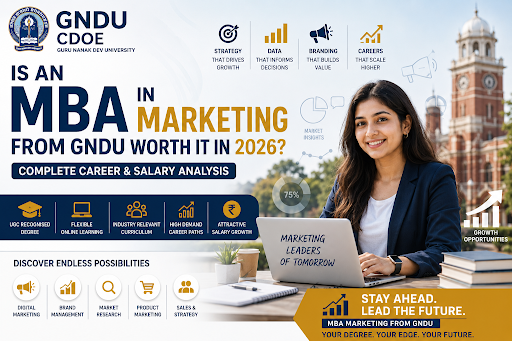
A counsellor's honest read on what the qualification delivers and what the market is actually rewarding right now.
There is a specific kind of frustration that marketing professionals describe three years into their careers, the feeling that their qualification taught them to think about marketing as it existed five years before they graduated. Brand funnels, segmentation models, and ATL-BTL planning. Solid frameworks. But frameworks designed for a media landscape that no longer works the way the textbook assumed.
The 2026 marketing environment is not a variation of what came before. It is structurally different. Consumers now move across five or six touchpoints before making a decision. First-party data has replaced third-party cookies as the currency of digital targeting. AI-assisted content is compressing production cycles. And yet, organisations are not hiring fewer marketing professionals; they are hiring differently. The premium has shifted from execution to interpretation: people who can read a market signal, connect it to a strategic question, and act on it before the window closes.
This shift is why the 'is this degree worth it in 2026?' The question deserves a more precise answer than the usual list of job titles and salary bands. The real question is whether the programme produces the kind of marketing thinker the current market is selecting for. And on that question, a government university MBA carries a specific kind of credibility that the market continues to respect, particularly in roles that sit at the intersection of institutional trust, analytical rigour, and applied marketing strategy.
What the Current Market Is Actually Telling Us
Three demand signals are reshaping what marketing qualifications need to deliver in 2026, and understanding them changes how you evaluate any MBA programme.
The first signal is the collapse of the channel specialist. For years, 'digital marketing' as a skill category was sufficient differentiation. That moment is over. Organisations now expect their marketing managers to operate across channels, not as a generalist, but as a strategist who understands the interaction effects between channels. The person who only knows SEO or only knows brand management is a shrinking category of hire.
The second signal is the data-strategy fusion. Marketing analytics used to be a separate function, something the data team did and handed to the marketing team. That separation is dissolving. Marketing managers in 2026 are expected to hold their own in conversations about attribution modelling, customer lifetime value, cohort analysis, and campaign measurement. The MBA that does not develop this capacity is sending graduates into a conversation they can't finish.
The third signal and perhaps the most consequential is the return of brand as a long-term asset. After a decade of performance marketing dominance, major organisations are reinvesting in brand building. The pendulum has not swung back entirely, but the evidence is accumulating that pure performance marketing erodes brand equity over time. The marketing professional who understands both who can manage a performance campaign and articulate its implications for long-term brand health is the profile most organisations are trying to hire and struggling to find.
The Human Reality: What Candidates Are Actually Weighing
Most people considering this programme are not starting from zero. They are carrying a specific professional question, sometimes clearly articulated, sometimes not.
A common profile is the working professional in their late twenties or early thirties who has been doing marketing execution, running campaigns, managing vendors, producing content and who has hit a ceiling. They can feel that their current role is not requiring them to think at the level they're capable of. They know an MBA credential would open a conversation about senior marketing roles, but they're uncertain whether the investment of time and money will translate into the career step they're imagining.
The second profile is the recent graduate who chose a non-business undergraduate path in humanities, sciences, engineering and has decided that marketing is where they want to build. They want the credentialled entry point that an MBA provides, but they're anxious about whether they'll be competitive against candidates who studied business from the start.
For both profiles, the flexibility offered by an online MBA in Punjab changes the calculus significantly. The ability to study without pausing a career, without relocating, and without the financial exposure of a full-time residential programme removes the three most common structural barriers to postgraduate study. The question shifts from 'can I afford to do this?' to 'is this the right programme for what I'm trying to build?'
An Honest Answer to Who Should Pursue This
Who should pursue this:
You are the right candidate if your goal is a career in marketing strategy, brand management, digital marketing leadership, product marketing, or market research and you want a qualification that is academically rigorous, institutionally credible, and practically oriented. You are also the right candidate if you are a working professional who needs the MBA credential to cross into senior roles without pausing your current career trajectory.
Who should reconsider:
If you are primarily looking for a highly specialised technical marketing credential, a programme that goes deep into one specific area, like performance marketing or marketing technology, a focused certification programme might serve that goal more efficiently. An MBA is a general management qualification with a marketing specialisation. Its value is breadth-with-depth, not narrow technical mastery.
What happens if this decision is delayed:
In a market where senior marketing roles are increasingly requiring both strategic capability and a postgraduate credential, the professional who delays the qualification typically finds themselves in a narrowing band of eligibility. Roles that were accessible with experience alone are increasingly requiring the combination. The professional who waits two or three more years before pursuing the MBA may find that the credential they eventually earn is being compared unfavourably against candidates who earned it earlier and have had time to apply it.
What the Programme Is Built to Deliver
The MBA admission process at GNDU is designed to be accessible to candidates from diverse academic backgrounds, a deliberate design choice that reflects the programme's philosophy that marketing thinking is not the exclusive property of business undergraduates. Candidates from humanities, sciences, and technical backgrounds have consistently brought perspectives to marketing strategy that conventional business graduates do not.
Eligibility at a glance: A Bachelor's or Master's degree in any discipline or an equivalent examination with a minimum of 50% aggregate marks. The programme does not prescribe a specific subject background, which means the entry bar is about academic seriousness, not disciplinary origin.
Inside the Curriculum: What Gets Built and Where It Lands
The MBA marketing subjects are structured to move from foundational business competency to marketing specialisation, with the depth increasing progressively across the programme. Here is what the curriculum develops and where each component connects to actual job functions:
| Curriculum Area | Job Function It Feeds |
|---|---|
| Marketing Management & Strategy | Brand Manager, Marketing Director, Category Manager |
| Consumer Behaviour & Psychology | Market Research Analyst, Insights Manager, UX Strategist |
| Digital Marketing & Analytics | Digital Marketing Manager, Growth Analyst, Performance Marketer |
| Sales & Distribution Management | Sales Strategy, Channel Manager, Trade Marketing |
| Advertising & Brand Communication | Brand Communication, Creative Strategy, Account Planning |
| Research Methods & Data Interpretation | Market Research, Business Intelligence, Strategy Consulting |
| International Marketing | Export Marketing, Global Brand Management, International Business |
| Product & Pricing Strategy | Product Manager, Revenue Manager, Pricing Analyst |
The curriculum's design logic is integration: no subject sits in isolation. A student studying consumer behaviour is expected to connect it to campaign design; a student studying pricing strategy is expected to connect it to brand positioning. This integration, when it works, produces graduates who think across functions rather than within them.
Specialisations: Where the Degree Gets Specific
The MBA specialisations in GNDU allow students to channel their learning toward the marketing domains most aligned with their career direction. Each specialisation deepens the core marketing curriculum in a specific direction without abandoning the general management foundation that makes the MBA credential broadly applicable.
The specialisation choice matters more than most students realise at the point of application. In most cases, the electives and project work associated with a specialisation become the most visible part of a graduate's portfolio, the work they discuss in interviews, the experience they reference in applications, the signal they send about where they want to build depth. Choosing a specialisation strategically aligned to both genuine interest and market demand is one of the highest-leverage decisions a student makes during the programme.
The Career Scope: What the Market Is Hiring and What It Pays
The MBA marketing career scope in 2026 is wider than it has historically been, but it is also more differentiated. The graduate who understands where the demand is concentrated and who positions themselves accordingly will have a materially different early career experience than one who relies on generic 'marketing jobs' searches.
Here is an honest salary landscape based on current market patterns:
| Role | Entry Level (0–2 yrs) | Mid Level (3–6 yrs) |
|---|---|---|
| Brand / Marketing Executive | ₹3.5 – ₹5.5 LPA | ₹7 – ₹12 LPA |
| Digital Marketing Manager | ₹4 – ₹6.5 LPA | ₹9 – ₹16 LPA |
| Market Research Analyst | ₹3.8 – ₹5.5 LPA | ₹8 – ₹14 LPA |
| Product Marketing Manager | ₹5 – ₹8 LPA | ₹12 – ₹20 LPA |
| Sales & Marketing Manager | ₹4.5 – ₹7 LPA | ₹10 – ₹18 LPA |
| Content & Brand Strategist | ₹3.5 – ₹5 LPA | ₹7 – ₹13 LPA |
A pattern worth noting: in most cases, the salary jump between entry and mid-level is not primarily driven by years of experience; it is driven by demonstrated strategic capability. The graduate who arrives with analytical depth, a strong project portfolio, and the ability to connect marketing decisions to business outcomes moves through this range faster than the one who accumulates years without accumulating depth.
Where the Demand Is Actually Concentrating Right Now
Rather than a generic five-year outlook, it is more useful to identify where the demand is specifically concentrating in 2026, the roles and capabilities that are generating the most active hiring across sectors.
Marketing Analytics and Data Interpretation:
The single fastest-growing sub-function within marketing hiring. Organisations across FMCG, fintech, e-commerce, and healthcare are building internal analytics capacity, and the shortage of people who can both run analysis and communicate it to non-technical stakeholders is acute. An MBA graduate who comes with strong quantitative coursework and project experience in marketing analytics is entering one of the most undersupplied talent pools in the sector.
D2C Brand Management:
India's direct-to-consumer economy continues to expand, and the brand-building challenges it creates are fundamentally different from traditional retail marketing. D2C brands need marketing professionals who understand customer acquisition economics, retention marketing, community building, and brand storytelling simultaneously. This is a generalist-by-necessity environment where the MBA's breadth is an asset rather than a liability.
B2B Marketing:
Consistently underestimated by MBA marketing students who default toward consumer-facing roles. B2B marketing, account-based marketing, content marketing for complex purchase decisions, and sales-marketing alignment are highly skilled functions with strong compensation and lower candidate competition. The graduate who deliberately builds toward this space often finds faster career progression than peers competing in saturated FMCG or e-commerce roles.
Public Sector and Social Marketing:
For graduates interested in purposeful work, the expansion of government digital communication programmes and development sector marketing roles represents a growing and underpopulated career track. A government university MBA credential carries particular credibility in these spaces. The institutional alignment between qualification and sector is a genuine differentiator in applications to public sector roles, multilateral organisations, and development sector positions.
Key Takeaways
- The 2026 marketing market is rewarding an integration strategy, plus analytics, plus communication, and the MBA's curriculum breadth is aligned to this demand, not mismatched to it.
- The institutional credibility of a government university qualification matters specifically in public sector, development sector, and corporate governance-sensitive hiring contexts and these are precisely the spaces that are growing.
- The salary trajectory is steep for graduates who build analytical depth and project-based evidence alongside the credential. The qualification opens doors; what you do inside them determines the velocity.
- The online delivery model removes the most common structural barrier to postgraduate study without compromising the qualification's rigour or credibility.
- Specialisation choice is a strategic decision, not an administrative one. The student who aligns their elective choices and project work to a specific market demand, such as analytics, D2C, B2B, or public sector, builds a more differentiated profile than one who treats specialisation as a formality.