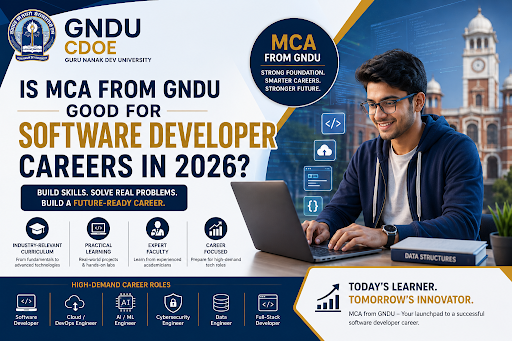
A grounded look at what the software industry is actually hiring for and how a master's in computer applications fits into that picture.
Something happened to the 'just learn to code and get placed' narrative somewhere around 2023, and it has not recovered. Mass layoffs at FAANG-adjacent companies, a visible slowdown in entry-level software hiring, the arrival of AI coding assistants that can generate boilerplate code faster than a junior developer, and a sharp increase in the technical bar for even mid-level roles. Candidates who were hoping that a computer science credential alone would produce a software career are discovering that the pipeline is narrower than the narrative suggested.
And yet the demand signal from the industry is not negative. It is selective. Organisations are not hiring fewer technology professionals. They are hiring differently. The work that is getting automated is the commodity layer: repetitive code generation, basic debugging, and template-driven development. The work that is expanding is the layer that requires systems thinking, architectural judgment, problem decomposition, and the ability to build and maintain complex software at scale. This is not a small distinction. It is the entire difference between a career that compounds and one that stagnates.
The question for any postgraduate computing programme in 2026 is not whether it produces candidates who can write code. Almost every graduate can do that. The question is whether it produces candidates who can think and look at a complex technical problem, break it into solvable components, choose the right tools for each, and build something that works reliably at scale. That is the standard the industry has shifted to. And it is, interestingly, precisely the standard that a well-designed Master of Computer Applications has always been oriented toward.
What the Industry Shift Actually Means and the Implication Nobody Talks About
Three structural changes are reshaping software developer hiring in 2026, and each one has a direct implication for how postgraduate computing education should be evaluated.
The first is the collapse of the junior generalist role. Entry-level developer positions that were essentially 'learn the codebase and start fixing small bugs' have shrunk significantly. The companies that are still hiring at the entry level are doing so for candidates who can contribute meaningfully from week one, candidates who understand data structures and algorithms deeply, who have built non-trivial projects, and who have exposure to version control, testing frameworks, and deployment pipelines. The margin for a slow ramp-up has narrowed. This is not a temporary trend. It reflects a structural change in how software teams are organised and what they expect from the people they hire.
The second structural change is the rise of full-stack thinking. The specialisation model front-end developers who don't touch back-end, back-end developers who don't understand infrastructure are under pressure. Modern software teams, particularly in product companies and startups, increasingly want engineers who can hold the full picture. Not necessarily experts in every layer, but capable of reasoning across layers and building vertically when needed. A computing curriculum that develops depth in multiple areas, such as systems programming, web development, databases, networking, and algorithms, produces exactly this kind of cross-layer thinker.
The third change is the professionalisation of software development. The developer who ships code is no longer the only valued profile. The developer who ships code, documents it properly, tests it systematically, reviews others' work constructively, and can explain technical decisions to non-technical stakeholders is the profile that senior roles are being filled by. This professionalisation mirrors what happened in other engineering fields a generation earlier. It favours candidates whose education included not just technical content but professional practice, and a postgraduate programme, by design, has more room for this than a three-year undergraduate degree compressed under credit-hour constraints.
What Candidates Are Actually Navigating Right Now
Most people considering a postgraduate computing programme in 2026 are carrying a specific version of the same uncertainty. They know the technology field is large. They know software salaries are strong relative to other sectors. But they are looking at a job market that seems simultaneously to have too many applicants and not enough hires, and they are trying to understand which side of that equation they are on.
A common profile is the BCA or BSc Computer Science graduate who has the foundational knowledge but senses correctly that a three-year undergraduate programme could only go so deep. They can build basic applications. They understand programming concepts. But they know they are not yet at the level where complex system design, advanced algorithms, or production-grade software development feels natural. They want the next level of technical depth, and they want it in a structured environment where they can build it properly rather than patching it together through self-study and online courses.
The second common profile is the working professional two or three years into a technical or semi-technical role who has hit a ceiling defined by their undergraduate qualification. They are doing the work of a developer but not being considered for senior developer or architect roles because the credential gap is real in their organisation's promotion process. They need the qualification upgrade, but they need it in a format that does not require them to stop working for two years.
For both profiles, the availability of an online MCA in Punjab resolves the structural tension between career continuity and academic progression. The working professional can build the credentials without pausing momentum. The recent graduate can access the programme without the financial and logistical overhead of full-time residential study. The delivery model is not a compromise on quality; it is a design feature that matches the reality of how computing professionals need to learn in 2026.
The Decision That Matters: Who Should Pursue This and Who Shouldn't
Who this is built for:
You are the right candidate if your goal is a substantive career in software development, building real systems, working on complex problems, growing toward architecture and senior engineering roles over a five-to-seven-year arc. You are also the right candidate if you are a working professional with a computing background who needs the postgraduate credential to unlock promotion pathways that your current organisation gates on qualification level. The MCA is a terminal master's in computing, which means the market reads it as a signal of serious, committed technical development, not a stepping stone to something else.
Who should think carefully:
If your goal is a highly specialised research role in AI research, computational theory, or academic computer science, then a research-oriented MSc with a thesis track may serve you better. The MCA is an applied programme. It produces strong practitioners, not theoretical researchers. That is a design choice, not a deficiency, but it is worth being clear about the distinction before choosing. Similarly, if you are looking for a shortcut to a software job without the underlying technical investment, no programme solves that problem. The MCA requires genuine engagement with challenging technical material.
What delay costs:
One of the most consistent patterns in technology careers is that the gap between a solid postgraduate foundation and a self-assembled skills patchwork widens over time, not narrows. The candidate who builds their technical depth systematically in a structured programme, with peer learning, with assessments that surface gaps, arrives at year three of their career with a fundamentally different capability profile than the one who accumulated the same years of experience without that foundation. That difference is visible in hiring conversations, in architecture discussions, and eventually in the roles and salary bands accessible at the five-year mark.
Inside the Curriculum: What Gets Built and Why It Matters
When candidates ask what are subjects in MCA, the honest answer is that the subject list is less important than understanding the intellectual architecture behind it. The curriculum is designed to move from computational foundations to applied systems development, building each layer on the one before it.
| Curriculum Area | What It Develops | Job Function It Feeds |
|---|---|---|
| Data Structures & Algorithms | Problem decomposition, optimisation thinking | Software Engineer, Competitive Programmer, SDE Roles |
| Operating Systems & Computer Architecture | Systems-level reasoning, memory & process management | Systems Programmer, Embedded, DevOps |
| Database Management Systems | Data modelling, query optimisation, storage design | Backend Developer, Data Engineer, DBA |
| Software Engineering & SDLC | Requirement analysis, design patterns, testing | Full-Stack Developer, QA Engineer, Technical PM |
| Computer Networks & Security | Network protocols, security fundamentals, API design | Network Engineer, Security Analyst, Cloud Developer |
| Web & Application Development | Full-stack development, UI/UX integration, REST APIs | Web Developer, Product Engineer, SaaS Developer |
| Machine Learning & AI Foundations | Model intuition, data pipelines, applied ML thinking | ML Engineer, Data Scientist, AI Product Developer |
| Cloud Computing & Distributed Systems | Scalability thinking, cloud architecture, microservices | Cloud Engineer, Backend Architect, DevOps Engineer |
The curriculum's most important feature is compounding: each area builds on the previous ones. A student who has absorbed data structures, operating systems, and networking has the foundation to genuinely understand distributed systems, not just use cloud services but reason about why they are designed the way they are. That systems-level reasoning is precisely what distinguishes the senior developer from the junior one.
The Salary Picture: What the Market Is Actually Paying
The question of MCA salary deserves a realistic answer across the full career arc, not just the entry-level number that promotional content tends to focus on.
| Role | Entry Level (0–2 yrs) | Mid Level (3–6 yrs) |
|---|---|---|
| Software Developer / SDE | ₹4 – ₹7 LPA | ₹10 – ₹20 LPA |
| Full-Stack Developer | ₹4.5 – ₹8 LPA | ₹12 – ₹22 LPA |
| Backend / API Developer | ₹4 – ₹7 LPA | ₹10 – ₹18 LPA |
| Cloud / DevOps Engineer | ₹5 – ₹9 LPA | ₹14 – ₹26 LPA |
| ML / AI Application Developer | ₹5.5 – ₹10 LPA | ₹15 – ₹30 LPA |
| Systems / Embedded Engineer | ₹4 – ₹6.5 LPA | ₹9 – ₹16 LPA |
| QA / Automation Engineer | ₹3.8 – ₹6 LPA | ₹8 – ₹15 LPA |
| Technical Product Manager | ₹6 – ₹10 LPA | ₹16 – ₹28 LPA |
The salary pattern that consistently emerges across the software industry is a non-linear progression. Entry salaries are moderate relative to the total career opportunity. The steep inflexion happens between years two and five, driven almost entirely by demonstrated capability, the quality of code written, the complexity of systems built, and the ability to architect solutions rather than just implement them. The MCA graduate who uses the programme to build genuine depth across systems, algorithms, and applied development arrives at year two as a materially different candidate from the one who accumulated the same time without that foundation.
The Roles the Industry Is Actually Competing to Fill
Rather than a speculative list of future trends, it is more useful to identify where the genuine hiring pressure is concentrated right now, the roles where demand is demonstrably ahead of supply and where an MCA-level technical foundation positions candidates strongly.
Cloud-Native Development:
Every organisation of meaningful scale is either on cloud infrastructure or migrating to it. The developer who understands cloud-native architectures, serverless computing, containerisation, microservices, and infrastructure as code is among the most actively sought profiles in 2026. Cloud certifications (AWS, Azure, GCP) built on top of an MCA's systems foundation create one of the strongest qualification stacks in the current market.
AI-Adjacent Engineering:
The popular narrative focuses on AI replacing developers. The more accurate picture is that AI is creating enormous demand for developers who can build with AI, integrating large language model APIs, building retrieval-augmented generation systems, developing AI-powered product features, and maintaining the infrastructure that AI applications run on. This is not AI research; it is applied engineering. An MCA graduate with strong programming fundamentals and exposure to machine learning concepts is well-positioned for exactly this work.
Cybersecurity Engineering:
India's digital infrastructure expansion, UPI, DigiLocker, government digital services, and fintech platforms have created a corresponding surge in demand for professionals who understand both software development and security. The developer who can build secure systems, conduct code reviews with security in mind, and understand vulnerability frameworks is a scarce profile. The MCA's computer networks and security curriculum provides the foundation; a specialisation or certification in cybersecurity builds the differentiation.
A software developer's career in 2026 is not a single track. It is a branching tree, and the branches that pay most generously are not the ones with the most applicants. Cloud engineering, AI-adjacent development, and security-aware software development all have significantly less competition per open role than generic 'software developer' positions. The candidate who builds deliberately toward one of these branches during the MCA programme through elective choices, projects, and self-directed specialisation is not just more competitive. They are competing in a different pool.
What Technical Hiring Managers Are Actually Looking For
The interview process for software roles has changed significantly over the past three years, and understanding what it now screens for changes how you should use the time during the programme.
Problem-solving under constraints is the first screen, not general coding knowledge.
The technical interview format has converged on a pattern: given a problem you have not seen before, with constraints on time and space complexity, can you decompose it, reason about trade-offs, and arrive at a working solution while explaining your thinking out loud? This is a direct test of the depth of data structures and algorithms. The MCA graduate who has genuinely worked through this material, not just passed exams on it, has a meaningful advantage in these interviews.
System design fluency is the second screen for mid-level and senior positions.
Can you design a scalable URL shortener, a ride-sharing backend, and a notification service? Can you reason about database schema choices, caching strategies, and failure modes? System design questions test whether a candidate understands software not as a collection of features but as a set of interacting systems with constraints and trade-offs. This is postgraduate-level thinking, and it is exactly what the MCA curriculum is designed to develop.
Portfolio evidence is the third screen, and it is the one most candidates underinvest in.
A GitHub profile with real projects, a deployed application, a contribution to an open-source repository, and a technical blog that explains a problem you solved are the artefacts that distinguish candidates in shortlisting processes where credentials alone are insufficient differentiators. The MCA student who uses the programme's project assignments as an opportunity to build a public portfolio leaves the programme with evidence, not just a certificate.
Key Takeaways
- The software industry is not hiring fewer; it is hiring more selectively. The candidates succeeding are those with systems-level thinking, genuine algorithmic depth, and the ability to build complex software, not just write code.
- The MCA's curriculum architecture from computational foundations through to applied development is precisely matched to the technical profile that the current market values. It builds the thinking, not just the syntax.
- The salary inflexion in software careers happens at year two to five, driven by demonstrated capability rather than years on a CV.
- Cloud-native development, AI-adjacent engineering, and security-aware development are the three fastest-growing, least-saturated specialisation tracks for MCA graduates entering the market in 2026 and 2027.
- The candidate who builds a public project portfolio during the programme, deploying applications, GitHub contributions, and documented technical work, leaves with evidence of capability that no credential alone can provide.