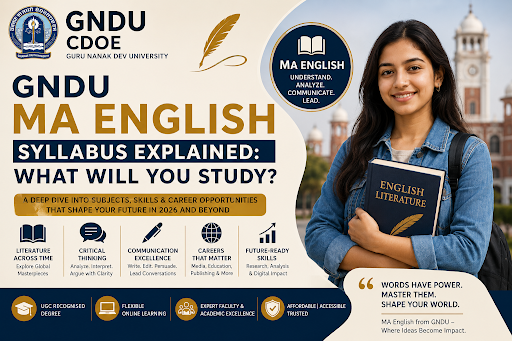
A subject-by-subject breakdown of what the MA English curriculum actually builds and why the English graduate's market value is being significantly underestimated in 2026.
There is a contradiction sitting in the middle of 2026's content economy that nobody seems to be talking about directly. AI can generate text faster than any human. And yet, demand for skilled writers, editors, content strategists, communication specialists, and language-trained professionals has not declined. In most sectors, it has grown.
The explanation is not as paradoxical as it first appears. AI can produce volume. It cannot consistently produce quality, nuance, cultural intelligence, or the kind of writing that actually changes how someone thinks. The organisations that tried to replace skilled communicators with AI-generated content in 2023 and 2024 largely discovered that they had created more text and less trust. The correction is underway. The premium on language professionals who can think, shape, and communicate with genuine craft has increased, not decreased, precisely because the commodity layer of writing has been automated away.
This is the context in which an MA in English literature and language should be understood in 2026. It is not a humanities degree competing awkwardly with STEM disciplines. It is the formal development of the one professional capability that AI has consistently failed to replicate at the level organisations actually need: the ability to read a complex situation, understand what it means, and communicate that meaning with precision and purpose.
The question is not whether an English postgraduate degree is relevant. The question is whether the person pursuing it understands what their skills are actually worth and positions themselves accordingly.
What Studying English at the Postgraduate Level Actually Develops
Most people outside the discipline misread what an MA English programme is. They see a literature degree and assume it produces readers. What it actually produces when the programme is well-designed, and the student engages seriously, is a particular kind of thinker.
The core skill is close reading: the ability to attend carefully to language, to notice what is said and what is not said, to understand how form shapes meaning, and to hold multiple interpretations simultaneously without forcing premature resolution. This is not a literary skill. It is a cognitive skill. The professional who can read a contract, a policy document, a client brief, or a strategic proposal with that level of attention is doing something qualitatively different from the person who reads for summary. They are finding the gap between what the text says and what it means, which is exactly the gap that creates value in most professional contexts.
The second skill is argument construction. Literary analysis is an argument. Every essay, every seminar paper, every critical reading exercise in an MA English programme is practice in building a case, marshalling evidence, anticipating counterarguments, establishing coherence, and arriving at a conclusion that the reader finds genuinely persuasive. This is the skill that makes English graduates effective in roles that require structured communication: policy writing, legal drafting, journalism, corporate communications, and academic research.
The third skill, the one most consistently undervalued by candidates themselves, is cultural and historical contextualisation. Understanding how texts operate within the social, political, and ideological conditions of their production is direct training in contextual analysis. The professional who can situate a message within its cultural context, anticipate how different audiences will receive it, and adjust the framing accordingly has a capability that is genuinely rare and consistently in demand.
What MA English Students Are Actually Wrestling With
The most common anxiety among MA English students and among prospective candidates considering the programme is not about the content of the course. It is about what comes after. They enjoy the reading, the seminars, and the intellectual engagement with literature. What they are less certain about is whether any of that translates into a career with real economic value.
This anxiety is compounded by a specific cultural narrative that tells humanities graduates they made a risky choice, that the practical, employable degrees are elsewhere, and that an English postgraduate is a pleasant academic pursuit with limited professional consequences. A common pattern among English graduates who have built strong careers is that they internalised this narrative early, spent several years underselling their own capabilities in job applications and interviews, and only discovered the real market value of their skills when a manager or client pointed it out to them explicitly.
The second challenge is translation. English graduates often possess capabilities that are genuinely valuable but struggle to name them in the language that hiring processes use. 'I read nineteenth-century novels' does not communicate 'I can conduct detailed textual analysis, synthesise complex information from multiple sources, construct structured arguments, and produce polished written output under a deadline.' Both statements describe the same person. Only one gets shortlisted.
For candidates in Punjab and across North India, the accessibility of a distance MA English programme resolves a practical barrier that has historically kept working adults and geographically constrained candidates out of postgraduate study. The flexibility to engage with a rigorous academic curriculum without relocating or pausing employment changes the calculus significantly, particularly for candidates who have already built some professional experience and want to combine it with the credential and the intellectual depth that the programme provides.
Who Should Pursue This? An Honest Assessment
Who this is built for:
You are the right candidate if language, literature, and communication are genuinely the areas where your thinking is strongest, and you want to develop those capabilities to a postgraduate level in a structured environment. You are also the right candidate if you are working in a communication-adjacent field, such as journalism, content, teaching, public relations, publishing, and you want the credential and the intellectual foundation to move into more senior, more specialist, or more academically demanding roles. The MA English is particularly well-suited for candidates who want to teach, for those targeting editorial and publishing careers, and for those considering competitive examinations where English language and literature feature prominently.
Who should think carefully:
If your interest in English is primarily instrumental, you want the postgraduate qualification as a credential upgrade, but have limited genuine engagement with literature, language, or critical analysis, the programme will be more difficult and less rewarding than you expect. MA English is intellectually demanding in a specific way: it requires sustained engagement with complex texts, tolerance for interpretive ambiguity, and the willingness to build and defend arguments that do not have single correct answers. Candidates who thrive in highly structured, quantitative environments sometimes find this mode of thinking uncomfortable. That discomfort is information worth attending to before committing.
What delay costs:
For candidates who are already working in English-language professional environments without a postgraduate credential, the delay cost is specific: it is the ceiling effect. In editorial teams, content strategy functions, academic institutions, and government cultural bodies, the postgraduate qualification is frequently the threshold for senior roles. Working without it for an extended period can mean accumulating experience in a band that the qualification would have unlocked, which is a real opportunity cost that compounds over time.
The Syllabus, Explained: What You Will Actually Study
The MA English subjects are organised around a progression that moves from foundational literary and critical frameworks to specialised areas of study, building interpretive range across periods, geographies, genres, and theoretical traditions.
| Subject Area | What It Develops | Professional Application |
|---|---|---|
| British Literature: Renaissance to Romanticism | Textual analysis, historical contextualisation, genre study | Academic research, cultural writing, editorial work |
| Victorian & Modern British Literature | Social critique, narrative analysis, realism and modernism | Journalism, literary criticism, content strategy |
| American Literature | Comparative cultural reading, identity and power in texts | Cross-cultural communication, international publishing |
| Indian Writing in English | Postcolonial frameworks, linguistic hybridity, local voice | Indian media, cultural institutions, and regional publishing |
| Literary Theory & Criticism | Interpretive frameworks, structuralism, poststructuralism, feminism | Academic writing, policy analysis, and research roles |
| Language & Linguistics | Syntax, semantics, discourse analysis, language use in context | Language teaching, UX writing, communication consulting |
| Drama & Theatre Studies | Performance, dialogue, dramatic structure, audience awareness | Scriptwriting, media, training and development roles |
| Postcolonial & World Literatures | Global literary traditions, decolonial reading, comparative analysis | Development sector, international NGOs, cultural diplomacy |
| Research Methodology & Dissertation | Original research design, argument construction, and academic writing | Academic careers, research institutions, and think tanks |
The most important thing to understand about this curriculum is that it is not a reading list. It is a series of increasingly sophisticated exercises in the same core set of skills: attend closely, interpret carefully, contextualise accurately, and argue coherently. By the time a student reaches the dissertation stage, they have practised this sequence across dozens of texts, periods, genres, and theoretical frameworks. The depth that is produced is not easily replicated by self-directed reading; it comes from the friction of being challenged, assessed, and required to defend your interpretations to people who will push back.
The Career Translation: Where English Graduate Skills Land
The MA English career scope in 2026 is wider than most candidates assume and concentrated in areas that are growing, not contracting. The mistake is treating 'English jobs' as a single category. The actual opportunity set branches across five distinct professional domains, each with its own hiring patterns, salary structures, and growth trajectories.
Education and Academic Roles:
Teaching at the undergraduate and postgraduate level remains the most structured career pathway for MA English graduates, and it is one where the postgraduate credential is a formal requirement rather than a preference. In addition to university faculty positions, there is a substantial and growing private education sector, including language coaching, IAS English paper preparation, IELTS and TOEFL training, and international school teaching, where the combination of subject expertise and communication skills creates strong earning potential. Competitive examination coaching for English papers specifically is a high-income specialisation with a limited credentialled supply.
Content Strategy and Digital Communication:
This is the fastest-growing employment domain for English postgraduates in 2026. Organisations across every sector are building content functions, editorial teams, brand journalism units, thought leadership operations, and UX writing teams. The premium within this domain is shifting toward strategists: people who can not just write, but plan, commission, edit, and measure content at a programmatic level. An MA English graduate with writing depth and critical analysis capability enters this domain several levels above the self-taught content writer.
Publishing, Media, and Journalism:
Traditional publishing has contracted but not disappeared, and it has been supplemented by the explosive growth of digital media, audio journalism, newsletter publishing, and literary platforms. Editorial roles, copy-editing positions, sub-editing, commissioning roles, and literary agency work all require exactly the textual precision and cultural literacy that an MA in English develops. These roles are competitive, but they are competed for by a pool that is smaller and less credentialled than many candidates assume.
Civil Services and Government Communication:
A significant and consistently underappreciated career track for English postgraduates is competitive examination preparation, particularly for UPSC, where the optional paper in English Literature is one of the highest-scoring options for candidates who have studied it seriously. Beyond examinations, government communication roles, cultural institutions, and public sector publishing functions all hire language specialists. A Government University MA in English credential carries particular credibility in these institutional contexts. The public sector alignment between qualification type and employer preference is a genuine differentiator.
Corporate Communication and Public Affairs:
Every large organisation, bank, pharmaceutical company, technology firm, conglomerate runs a communication function. These departments need professionals who can write with precision, manage language across complex stakeholder environments, translate technical content for non-technical audiences, and maintain the organisation's written voice across multiple channels. The English postgraduate who positions themselves deliberately for this domain and builds sector-specific knowledge alongside linguistic capability enters a well-compensated function with genuine career progression.
Where the Jobs Are and What They Pay
The most common question about English literature jobs is not whether they exist, but whether they pay well enough to justify the investment of a postgraduate degree. The honest answer is: it depends entirely on which part of the market you enter and how deliberately you position yourself within it.
| Role / Career Track | Entry Level (0–2 yrs) | Mid Level (3–6 yrs) |
|---|---|---|
| University / College Lecturer | ₹3.5 – ₹5.5 LPA | ₹6 – ₹12 LPA + benefits |
| Content Strategist / Senior Writer | ₹4 – ₹7 LPA | ₹10 – ₹20 LPA |
| Editor / Sub-Editor (Publishing/Media) | ₹3.8 – ₹6 LPA | ₹8 – ₹15 LPA |
| Corporate Communication Manager | ₹5 – ₹8 LPA | ₹12 – ₹22 LPA |
| UX Writer / Content Designer | ₹4.5 – ₹8 LPA | ₹12 – ₹22 LPA |
| IAS/PCS English Optional Coaching | Variable/freelance | ₹8 – ₹20 LPA (established) |
| Public Affairs / PR Specialist | ₹4 – ₹6.5 LPA | ₹9 – ₹18 LPA |
| Academic Researcher / PhD Track | ₹3 – ₹5 LPA (fellowship) | Faculty + research grants |
The pattern worth noting: the salary gap between English career tracks is not random. It correlates directly with how specifically the candidate has positioned themselves and how clearly they can connect their linguistic and analytical capabilities to organisational outcomes. The English postgraduate who frames their skill as 'I studied literature' earns at the lower end. The one who frames it as 'I can build and manage the communication function that shapes how your organisation is perceived and understood' earns at the upper end. Same degree. Different positioning.
What Employers Will Be Looking for When You Graduate
The English graduate's market is being reshaped by three converging forces that will be fully visible in the hiring cycle over the next two to four years.
The first is the post-AI content correction. After two years of AI-generated content flooding digital channels, audiences and algorithms are both beginning to reward quality signals, originality, voice, depth, and the kind of cultural specificity that AI cannot synthesise. Organisations that want to stand out in this environment are not looking for more AI outputs managed by someone with a content calendar. They are looking for genuine language professionals who can build editorial standards, make curatorial judgments, and produce work that earns attention rather than simply occupying space. This is not a nostalgic argument for old-school publishing. It is a market correction that is creating real demand for real language skills.
The second force is the growth of India's English-language cultural economy. Indian literary fiction, journalism, podcasting, digital long-form, and streaming content are all expanding significantly. The people who create, edit, develop, and manage this content need postgraduate-level language training. This is a domestic demand signal that has no ceiling in sight. India's English-language creative economy is in the early stages of a sustained expansion, not a mature phase.
The third force is the professionalisation of communication functions in Indian organisations. A decade ago, 'communications' in most mid-size Indian companies meant a press release and a PR agency. Today, it means a full editorial calendar, a social presence, a thought leadership programme, internal communications, investor relations language, and a crisis communication protocol. Each of these is a specialist function. The English postgraduate who understands language at depth, can write across formats and registers, and can think strategically about audience is entering a function that is growing in both scope and seniority.
Key Takeaways
- The 2026 content and communication economy is creating genuine, growing demand for English language professionals, not despite AI, but in response to it. The correction is underway.
- The MA English curriculum develops three professional capabilities that remain distinctively human and organisationally valuable: close reading, structured argumentation, and cultural contextualisation.
- The career scope is wide but differentiated. Content strategy, corporate communication, UX writing, and editorial roles pay significantly above the median for candidates who position their linguistic skills deliberately rather than generically.
- The postgraduate credential matters specifically in academic, government, and senior editorial contexts, where it is a formal threshold, not just a preference.
- The most consistent differentiator between English graduates who build high-value careers and those who don't is talent or knowledge. It is the ability to translate their capabilities into the language that employers use when they describe the problems they need solved.