A direct, career-focused read on the Punjabi language profession in 2026, the teaching pathway, the eligibility ladder, and the career doors most candidates don't realise are open.
There is a quiet assumption built into how most people talk about a postgraduate degree in Punjabi: that it leads to teaching, and that teaching is the ceiling. Both parts of that assumption are worth examining, because in 2026, neither is quite accurate.
On the teaching side, the demand picture is stronger than the narrative suggests. Punjab's school and college system is large. Government school teacher recruitment through PSTET and PPSC continues at scale. College and university lecturer positions, while competitive, are a structured, well-defined career ladder with UGC-governed salary scales that compare favourably with private sector equivalents. The NET-qualified MA Punjabi graduate who pursues the lecturer route is entering a career path with genuine job security, structured progression, and growing social recognition of Punjabi language instruction as an institutional priority in the state.
But the more interesting shift is what is happening outside the classroom. Punjabi is experiencing a significant cultural and commercial revival that most academic conversations about the language have not yet caught up with. The global Punjabi diaspora, estimated at over ten million people across the UK, Canada, the United States, and Australia, has created a substantial English-Punjabi content economy. Punjabi music, cinema, and digital media have become mainstream cultural forces in India and internationally. Government digital initiatives are expanding Punjabi-language services. And the demand for Punjabi language professionals in translation, media, content creation, and cultural programming has grown in proportion.
This is the context in which the question 'can I become a lecturer?' should be answered not as a narrow yes/no about one career path, but as an entry point into a much wider professional conversation.
What Studying Punjabi at the Postgraduate Level Actually Builds
The misreading of what an MA in Punjabi produces is similar to the misreading of other humanities postgraduates, and it has the same career consequences. Candidates who understand only the surface of what the programme develops significantly undervalue themselves in the job market.
At the core, an MA Punjabi builds literary and linguistic expertise: a deep familiarity with the Punjabi literary tradition from medieval Gurbani poetry through to contemporary fiction and criticism, combined with rigorous training in linguistic analysis, grammar, and the structural mechanics of the language. This expertise is the foundation of the teaching qualification, but it is also the foundation of every other professional application.
The second layer is critical analysis. Reading literary texts analytically, understanding how form, language, and cultural context interact to produce meaning, is not a subject-specific skill. It is a transferable cognitive capability. The MA Punjabi graduate who has spent two years producing literary analysis has developed the same close-reading and argument-construction capability that makes language graduates valuable in editorial, communication, and research contexts.
The third layer and the one with the most immediate 2026 relevance, is cultural mediation. The ability to operate fluently in both Punjabi and English, to understand the cultural logic of Punjabi texts and traditions, and to translate that understanding for different audiences is a specific professional competency. It is in demand in translation, diaspora media, cultural programming, government communication, and cross-cultural consultancy. The MA Punjabi graduate with this capability is not a language specialist in a narrow sense. They are a cultural bridge, and that bridge has real commercial and institutional value.
What Candidates Are Actually Weighing
Most people considering this programme fall into one of three profiles, and each is navigating a different version of the same question about whether the investment is worth it.
The first profile is the undergraduate Punjabi or humanities student who has a genuine affinity for the language and literature but is uncertain whether that affinity translates into a viable career. They can see the teaching pathway clearly, NET, PSTET, lectureships, and schools, but they are not sure whether it is a path with enough opportunities and enough financial stability to commit to. The anxiety is not about the programme. It is about the endpoint.
The second profile is the working professional already in a teaching role at the school level who needs the postgraduate qualification to access the lecturer or assistant professor track. They know exactly what they want. The question for them is access: can they complete the programme without pausing their current employment and income?
The third profile is the candidate who is genuinely interested in Punjabi language and culture but is also open to non-teaching careers, translation, media, content, cultural sector work and wants to know whether the MA provides the foundation for both directions or commits them narrowly to one.
The Online MA Punjabi format directly serves the second profile, the working professional who needs the qualification without the residential overhead. But it also serves the first and third profiles in a specific way: the flexibility to complete the programme while building early professional experience in teaching, tutoring, translation, or content work means that by graduation, the candidate has both the credential and demonstrated experience. That combination is materially stronger than the credential alone.
The Lecturer's Question Answered Directly
Can you become a lecturer after this programme?
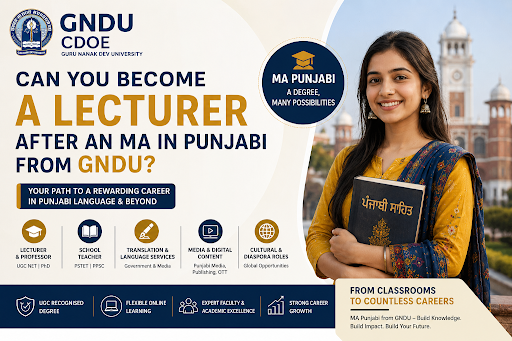
Yes, with a structured additional step. The MA qualification is the foundation. To teach at the college or university level in India, you additionally need to qualify in UGC NET (National Eligibility Test) in Punjabi or hold a PhD. A NET qualification opens Assistant Professor positions across colleges and universities. A PhD, typically pursued after NET or alongside it, opens the full academic career ladder, including associate professorships and professorships. The MA from a recognised university, which is a postgraduate degree from an established government institution, is the eligibility requirement for appearing in NET. The pathway is: MA → NET → Assistant Professor. It is structured, it is well-defined, and it is actively hiring.
What about school teaching?
School-level Punjabi teacher recruitment operates on a parallel track. PSTET (Punjab State Teacher Eligibility Test) is the qualification gateway for government school teaching positions in Punjab. PPSC recruitment processes fill positions at the government high school and senior secondary level. These are competitive examinations with structured syllabi, and the MA Punjabi curriculum is directly aligned to the content tested. School teaching positions offer job security, pension benefits, and structured pay scales that make them among the more stable career options available to language graduates.
Who should reconsider the teaching track:
If your primary motivation for the MA Punjabi is credential acquisition with minimal engagement in the subject, treating the degree as a checkbox, you will find the competitive examination route difficult. NET and PSTET require genuine subject mastery, and the candidates who score well are those who have engaged seriously with the curriculum. The programme rewards intellectual commitment, not just attendance. If you bring that commitment, the qualification ladder is accessible, and the career stability at the end of it is real.
What the delay costs:
For candidates already working at the school level who want to transition to college teaching, the delay in completing the MA is directly a delay in NET eligibility. Every year without the postgraduate qualification is a year that cannot be counted toward the teaching experience often required alongside NET for senior lecturer applications. The compounding cost of delay in academic careers is real and specific; it is measured in application cycles missed, not in vague opportunity costs.
The Curriculum: What the Programme Actually Covers
Understanding the Punjabi literature subjects requires seeing the curriculum not as a reading list but as a systematic development of the language and literary knowledge that the academic and professional careers depend on.
| Subject Area | What It Develops | Professional Application |
|---|---|---|
| Medieval Punjabi Literature (Gurbani, Sufis, Qissas) | Classical literary tradition, theological and philosophical interpretation | Academic research, religious education, and cultural heritage work |
| Modern Punjabi Poetry and Fiction | Contemporary literary analysis, genre study, and close reading | Literary journalism, publishing, critical writing |
| Punjabi Drama and Theatre | Dramatic structure, performance context, dialogue analysis | Scriptwriting, media production, arts programming |
| Punjabi Linguistics and Grammar | Language structure, syntax, phonology, dialect variation | Language teaching, translation, NLP-adjacent roles |
| Literary Criticism and Theory | Critical frameworks, interpretive methodology, and argument construction | Academic publishing, research institutions, and editorial work |
| Dalit and Progressive Literature | Social and political reading of literature, identity in texts | NGO communication, social sector writing, advocacy |
| Partition Literature | Trauma narratives, historical contextualisation, memory and text | Archive work, cultural institutions, documentary content |
| Translation Studies | Punjabi-Hindi-English translation practice, equivalence theory | Professional translation, subtitling, and government language services |
| Research Methodology and Dissertation | Original research design, academic writing, sustained argument | PhD preparation, research institutions, and competitive examinations |
A detail worth noting: the NET Punjabi examination syllabus maps closely onto this curriculum. Students who engage seriously with medieval literature, linguistics, literary theory, and the modern literary tradition are building the subject knowledge that competitive examination success depends on. The programme is not just academic preparation for candidates pursuing the lecturer route, it is examination preparation.
Beyond the Classroom: Where Punjabi Language Skills Are in Demand
The Punjabi language careers available in 2026 extend well beyond the teaching sector, and several of these adjacent tracks are growing faster than the academic one. Understanding the full map changes how candidates should think about the programme's value.
Translation and Language Services:
This is the most direct professional application of MA Punjabi skills outside teaching, and it is a genuine growth area. Government digital services require Punjabi translation across legal documents, welfare schemes, health information, and official communications. The entertainment industry requires subtitling and dubbing translation. International organisations working in Punjab require English-Punjabi language support. The MA Punjabi graduate with strong translation competency, particularly bilingual proficiency at a postgraduate level, is well-positioned for certified translation roles, government language services, and media localisation work.
Punjabi Media and Digital Content:
Punjab's Punjabi-language media ecosystem includes substantial television channels, digital news platforms, podcasting, YouTube channels with large audiences, and social media content creators with professional content needs. Behind every piece of polished Punjabi media content is a professional who can write, edit, and script in the language with accuracy and cultural intelligence. The MA Punjabi graduate who combines linguistic training with digital media skills enters one of the most actively growing employment areas for language professionals in the state.
Cultural Institutions and Heritage Organisations:
Punjab has a rich network of cultural institutions, such as Sahitya Akademi, Punjab Arts Council, Punjab Heritage and Tourism Promotion Board, and language departments in the central and state government that regularly employ Punjabi language specialists for curatorial, editorial, research, and programme management roles. These positions are not high-volume hires, but they are prestigious, well-compensated relative to the field, and accessible to candidates with strong academic credentials in Punjabi literature and culture.
Diaspora-Facing Education and Media:
The global Punjabi diaspora has created a sustained demand for Punjabi language instruction, cultural programming, and media content targeted at second and third-generation diaspora communities. UK Punjabi schools, Canadian Punjabi language programmes, diaspora cultural organisations, and international Gurdwaras all employ Punjabi language educators and content professionals. This is a career track that is largely invisible in domestic job market conversations but is real, growing, and well-compensated.
The Teaching Jobs Picture: Opportunities and What They Pay
The question of teaching jobs after MA Punjabi has a more structured answer than most candidates receive. Here is a realistic map of the positions, eligibility requirements, and compensation across the teaching career ladder:
| Position | Key Requirement | Approximate Salary |
|---|---|---|
| Government Primary / Middle School Teacher | BA + B.Ed + PSTET Paper I | ₹35,000 – ₹50,000/month (7th Pay) |
| Government High School Punjabi Teacher | MA Punjabi + B.Ed + PSTET Paper II | ₹44,000 – ₹65,000/month (7th Pay) |
| Government Senior Secondary Teacher | MA Punjabi + B.Ed + PPSC / PSTET | ₹47,000 – ₹70,000/month (7th Pay) |
| College Assistant Professor (Government) | MA Punjabi + UGC NET / PhD | ₹57,700 – ₹98,000/month (UGC 7th Pay) |
| College Assistant Professor (Private Aided) | MA Punjabi + UGC NET | ₹35,000 – ₹60,000/month (varies) |
| University Assistant Professor | MA Punjabi + UGC NET + PhD preferred | ₹57,700 – ₹1,00,000+/month (UGC scale) |
| Private School Punjabi Teacher | MA Punjabi + B.Ed | ₹18,000 – ₹40,000/month (highly variable) |
The salary picture for government teaching roles is considerably stronger than the private sector conversation about 'teaching jobs' suggests. UGC-scale assistant professor positions at government colleges are among the best-compensated entry-level professional positions available to postgraduate humanities candidates, particularly when the full package (job security, pension, leave entitlements, and salary progression) is considered alongside the base salary.
The Signals Shaping Punjabi Language Professional Demand
Three forces are reshaping demand for Punjabi language professionals over the next three to four years, and each one creates a different kind of opportunity for MA graduates who are paying attention.
The first is State Language Policy and Digital Governance: The Punjab government's ongoing push to expand Punjabi-medium education and digitise government services in Punjabi is generating sustained demand for language professionals in government departments, education boards, and digital services agencies. This is institutional demand, not cyclical, and it creates stable, recurring hiring in translation, language quality assurance, content development, and Punjabi-medium curriculum design.
The second force is the Global Punjabi Media Expansion: Punjabi music and cinema have crossed over into mainstream international markets in a way that few regional Indian languages have achieved. This has created a growing professional infrastructure around the content production companies, media platforms, talent management, and music publishing that needs Punjabi language professionals with both literary training and media sensibility. The career track is less structured than teaching but potentially more lucrative for candidates with the right combination of skills and entrepreneurial orientation.
The third force is the Language Technology Opportunity: Natural language processing and AI language models require language-specific training data, quality annotation, and cultural accuracy review. Punjabi is a language for which high-quality annotated data is in comparatively short supply, which creates a specific and growing demand for Punjabi language specialists who can work with language technology teams. This is not a traditional language career, but it is a real and growing one, and it pays well. The MA Punjabi graduate who develops awareness of this domain during the programme is ahead of an opportunity that most of their peers will discover only after graduation.
Why Institutional Choice Matters for This Specific Career Path
For the competitive examination and academic career route, institutional credibility is not incidental it is directly relevant. A Government University Punjabi Course carries specific weight in the contexts that matter most: NET application eligibility, PPSC and PSTET qualification recognition, college and university appointment processes, and the academic reference letters that PhD applications depend on.
The faculty research output, examination rigour, and curriculum depth of an established government university with a dedicated Punjabi department are the foundation on which competitive examination preparation is built. Candidates who study in environments where the academic standards are high and the faculty are active researchers emerge with a different quality of subject knowledge than those who pass through less demanding programmes. In competitive examinations where the margin between selection and non-selection is narrow, that difference in subject depth is what it comes down to.
Key Takeaways
- Yes, you can become a lecturer after this programme. The pathway is structured: MA → UGC NET → Assistant Professor. It is well-defined, actively hiring, and financially strong at the government college and university level.
- The teaching career is not the ceiling. Translation, Punjabi media, cultural institutions, diaspora education, and language technology are all growing tracks for MA Punjabi graduates, and most candidates are not yet aware of them.
- The curriculum is directly aligned to NET, PSTET, and PPSC examination syllabi. Serious engagement with the programme is simultaneously competitive examination preparation.
- Government teaching positions at the college and university level are among the best-compensated entry-level professional positions available to postgraduate language graduates, particularly when the full package of salary, security, and progression is considered.
- The Punjabi language is in a period of commercial and cultural revival in digital media, global diaspora markets, and government digital services. The professional opportunity set is expanding, not contracting.
Frequently Asked Questions
First, complete an MA in Punjabi from a recognised university. This is the eligibility threshold for the next step.
Second, qualified in UGC NET (National Eligibility Test) in Punjabi. NET is conducted by the National Testing Agency (NTA) and is held twice a year. Qualifying in NET makes you eligible for Assistant Professor positions across colleges and universities in India.
Third, apply for Assistant Professor positions as they are advertised through university recruitment drives, state government college recruitment processes, or aided college appointments.
Progression through the academic pay levels happens through Assessment Based Promotions (PBAS), typically at the 4-year, 10-year, and subsequent marks and eventually to Associate Professor and Professor grades.
At the top of the academic ladder, professor-level positions at central universities can reach ₹1,80,000 to ₹2,20,000 per month, including all allowances.